
When the remnants of Hurricane Ida stalled over New Jersey on September 1, 2021, Union County learned how fast a dry basement can become a swimming pool. Weather spotters recorded more than 9 inches of rain in Cranford, roughly 7.8 inches in Clark, about 7.5 inches in Westfield and New Providence, and over 6 inches in Springfield and Mountainside. In Scotch Plains, local officials reported totals of up to 10 inches. Most of that fell in a few hours.
Ida was extreme, but it was not a one-time event. Heavy summer downpours and fall nor’easters keep testing basements in Garwood, Cranford, Westfield, Scotch Plains, Fanwood, Clark and the surrounding towns every year. If water came into your basement after the last big storm, this guide covers what to do in the first 48 hours, why it happened, and how to keep it from happening again.
Why Basements in Our Towns Flood After Heavy Rain
A-1 Basement Solutions is based on North Avenue in Garwood, and our crews work in these neighborhoods every week. The same handful of local conditions show up again and again:
- The Rahway River basin. Cranford, Garwood, Clark, Westfield, Springfield and Mountainside all sit in or near the Rahway River watershed. When the river and its branches run high, groundwater around nearby homes rises with them, and older basements with no drainage system have nowhere to send that water.
- Runoff from the Watchung slopes. Homes in Mountainside, Scotch Plains, New Providence and Berkeley Heights sit below or along the ridge. Rain that falls uphill moves through the soil and pushes against foundation walls lower down, often entering at the cove joint where the wall meets the floor.
- Green Brook and local streams. In Scotch Plains, Green Brook and smaller local streams rise fast in heavy rain, and nearby Fanwood neighborhoods see the ground saturate quickly.
- The Passaic River lowlands. In Long Hill and parts of Berkeley Heights, flat ground near the Passaic River and the Great Swamp keeps the water table high for days after a storm.
- Older housing stock. Many homes in Westfield, Cranford and Fanwood were built before modern drain tile and sump systems were standard. Block or poured walls from that era often have no exterior waterproofing left.
In all of these cases, the problem is hydrostatic pressure: saturated soil presses water through cracks, pipe penetrations and the joint at the base of the wall. Sealing a crack from the inside does not change that pressure, which is why so many basements leak again after the next storm.
What to Do in the First 48 Hours After Your Basement Floods
1. Make it safe before you go down
If water is near outlets, a furnace, a water heater or an electrical panel, do not walk into it. Call your utility or an electrician to cut power to the basement first. Keep children and pets out.
2. Document everything
Take photos and video of the water level, the entry points and damaged belongings before you move anything. Your insurance company and your waterproofing contractor will both want to see where the water came in.
3. Find where the water is entering
Look for the source while it is still active. Common entry points include:
- The cove joint where the floor meets the wall
- Wall cracks, especially horizontal or stair-step cracks
- Basement window wells that filled up (see our guide to window well leak prevention)
- Floor drains backing up, which can point to a sewer issue rather than groundwater
- Water rising through floor cracks, a sign of high groundwater under the slab
Knowing the source matters. Water through a window well calls for a different fix than water coming up through the floor. Our article on basement leak detection walks through each one.
4. Remove water and dry out
Pump out or wet-vac standing water, move wet items out, and run fans and a dehumidifier around the clock. Pull up wet carpet and padding; they rarely dry out completely. The goal is to get the space dry within 24 to 48 hours.
5. Check your sump pump
If you have a sump pump, check whether it ran. In big storms, many basement floods happen because the power goes out and the pump stops, or because a single pump cannot keep up with the volume of water. If yours failed, read our homeowner guide to sump pump backup power and our guide on how sump alarms help prevent basement damage.
Long-Term Fixes That Keep Water Out Next Storm
Cleanup gets you back to dry. Keeping it dry the next time a storm stalls over Union County takes a system that manages the water instead of just blocking it.
Interior drainage (French drain) systems
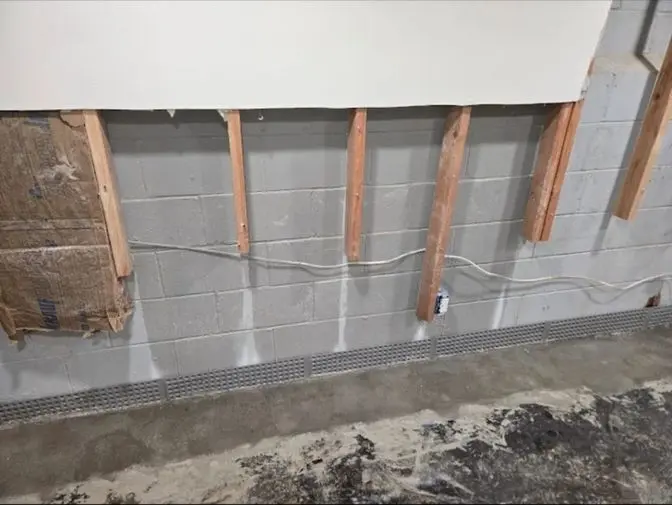
An interior perimeter drain is installed below the basement floor along the footing. It collects water at the point where it enters, before it reaches the floor, and carries it to a sump pit. This is the most reliable solution for the high groundwater common near the Rahway River and in Long Hill. Learn more in our post on interior French drains in NJ.
Sump pump with battery backup
A sump pump is only as good as its power supply. A primary pump paired with a battery backup, plus a high-water alarm, keeps working when the power goes out, which is exactly when storms like Ida hit hardest.
Crack repair and wall sealing
Wall cracks that leak should be repaired, but crack repair works best as part of a complete drainage plan, not as a stand-alone fix.
Exterior grading and downspouts
Make sure soil slopes away from your foundation and downspouts discharge at least several feet from the house. These simple steps reduce how much water reaches your walls in the first place.
At A-1 Basement Solutions, every system is installed by our own W2 employees, never subcontractors, and is backed by our transferable Life-of-the-House Guarantee. See our full basement waterproofing services.
Frequently Asked Questions
Does homeowners insurance cover a flooded basement in New Jersey?
It depends on the cause. Standard policies often exclude groundwater seepage and flooding, while some cover sudden events such as a burst pipe. Sewer backup and sump pump failure usually require a separate rider. Call your agent and review your policy before the next storm.
My basement only leaks in big storms. Do I still need waterproofing?
Yes. A basement that leaks only during heavy rain is telling you the groundwater has a path inside. Each storm can wear that path larger, and the next severe storm may bring far more water than the last one.
How fast can a waterproofing system be installed?
Most interior drainage and sump pump installations in a typical single-family home take one to three days, depending on the size of the basement and the work needed.
Do you serve my town?
Yes. We are based in Garwood and work throughout Cranford, Westfield, Scotch Plains, Fanwood, Clark, Mountainside, New Providence, Berkeley Heights, Long Hill, Springfield and nearby communities.
Get Your Basement Ready Before the Next Big Storm
If water came into your basement during the last heavy rain, it will find its way back. A-1 Basement Solutions will inspect your basement, find where the water is entering and recommend a permanent fix. Call 908-322-1313 or contact us online to schedule your inspection.