
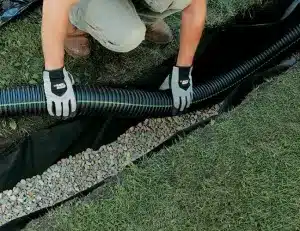
Few things are more frustrating for a New Jersey homeowner than walking downstairs after a heavy rainstorm only to find water pooling on the basement floor. In states like New Jersey—where coastal Nor’easters, rapid snowmelts, and dense clay soils are common—basement seepage is an ongoing struggle. While many homeowners try temporary fixes like waterproof paint or surface sealant sprays, long-term protection requires relieving the underlying pressure beneath your foundation. An interior French drain is the gold standard solution to keep your basement dry permanently.
Understanding Hydrostatic Pressure in New Jersey Homes
To understand why basements leak, you must first understand hydrostatic pressure. New Jersey soil, particularly across North and Central Jersey, contains heavy concentrations of dense clay. When heavy rains hit, this soil holds water like a giant sponge, causing the groundwater table around your foundation to rise significantly.
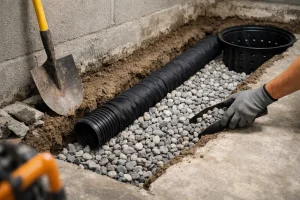
This trapped groundwater exerts thousands of pounds of hydrostatic pressure against your basement floor slab and foundation footings. Water always seeks the path of least resistance, forcing its way through the expansion joint—the seam where your concrete basement floor meets the outer foundation walls. Over time, this constant water pressure causes basement dampness, floor cracks, and costly water damage.
How an Interior French Drain System Works
Unlike exterior drainage systems that require massive excavation around your yard and landscaping, an interior French drain is installed beneath your existing basement floor slab. It intercepts groundwater before it ever touches your finished floor or living space.
The step-by-step professional installation process includes:
- Slab Trenching: Technicians jackhammer a 12-to-18-inch border around the interior perimeter of your basement floor to expose the foundation footing.
- Excavation & Gravel Bedding: Dirt and debris are cleared out to create a sloped trench lined with washed drainage stone.
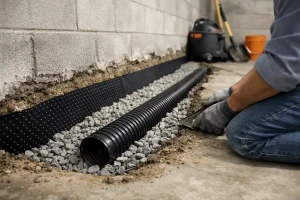
- Perforated Pipe Placement: Heavy-duty, perforated drainage pipe is laid inside the gravel bed along the entire perimeter, pitched directly toward a sump basin.
- Wall Vapor Barrier: A heavy-gauge vapor barrier is attached to the lower basement wall, directing any wall seepage straight down into the sub-slab channel.
- Concrete Restoration: The trench is backfilled with aggregate and capped with fresh concrete, restoring a smooth, clean basement floor.
Interior French Drains vs. Exterior Waterproofing
Homeowners often ask whether interior or exterior drainage is the better choice. Comparing the two methods highlights key differences in scope and investment:
| Feature | Sub-Slab Interior French Drain | Exterior Excavation Drainage |
|---|---|---|
| Installation Impact | Work done indoors; landscaping untouched | Requires heavy machinery and digging up yard |
| Installation Time | Typically 1 to 2 days | 5 to 7 days (weather dependent) |
| Long-Term Reliability | Protected from root intrusion and soil clogging | Prone to clogging over time from outside dirt |
| Average Cost in NJ | $4,000 – $10,000 | $12,000 – $25,000+ |
Cost Factors for NJ Interior French Drain Systems
On average, an interior French drain installation in New Jersey ranges between $50 and $80 per linear foot. The total project cost depends on several key factors:
- Perimeter Size: The total linear footage required to enclose your basement perimeter.
- Sump Pump System: Upgrading to a high-capacity primary sump pump with a battery backup system ensures continuous operation during severe storms and power outages.
- Basement Finishes: Removing existing drywall, framing, or flooring prior to trenching adds labor time.
Protect Your New Jersey Basement With A-1 Basement Solutions
Recurring basement water is more than an inconvenience. In North and Central New Jersey, heavy rainfall, snowmelt, clay-rich soils, and rising groundwater can create persistent hydrostatic pressure around foundations. An interior French drain provides a dependable way to capture that water below the basement floor and direct it safely toward a sump pump before it can damage your finished space.
A-1 Basement Solutions provides professional basement waterproofing and interior French drain installation throughout Northern and Central New Jersey, including communities across Bergen, Essex, Hunterdon, Middlesex, Morris, Passaic, Somerset, Sussex, Union, and Warren counties. Each drainage system is designed around the conditions of the individual home and installed by A-1’s trained, in-house W-2 crews rather than outsourced subcontractors.
Whether you are dealing with water along the basement floor-wall joint, recurring puddles after storms, foundation seepage, or an aging drainage system, A-1 Basement Solutions can evaluate the source of the moisture and recommend the appropriate waterproofing solution.
Backed by a Life-of-the-House Transferable Guarantee, A-1 helps New Jersey homeowners protect their basements, foundations, and usable living space for the long term. Contact A-1 Basement Solutions today to schedule a free in-home basement waterproofing consultation in New Jersey.
Frequently Asked Questions About Interior French Drains in NJ
How much does an interior French drain cost in New Jersey?
Interior French drain installation in New Jersey typically costs around $50 to $80 per linear foot, although the final price depends on basement size, drainage layout, sump pump requirements, accessibility, and whether finished walls or flooring need to be removed.
Are interior French drains effective for basement waterproofing?
Yes. Interior French drains are one of the most reliable solutions for managing groundwater and hydrostatic pressure beneath a basement floor. The system captures water before it reaches the finished basement and directs it toward a sump pump for removal.
How long does it take to install an interior French drain?
Most residential interior French drain systems can be installed in approximately one to two days. Larger basements, complex layouts, or additional waterproofing work may require more time.
Do I need a sump pump with an interior French drain?
In most cases, yes. The French drain collects groundwater beneath the basement floor and channels it toward a sump basin. The sump pump then removes that water and discharges it safely away from the foundation.
Can an interior French drain stop water coming through basement walls?
An interior French drain primarily manages groundwater entering near the floor and foundation footing. When combined with a basement wall vapor barrier or drainage membrane, it can also capture wall seepage and direct that moisture into the drainage system.
Is an interior French drain better than exterior waterproofing?
It depends on the property and source of the water problem. Interior French drains are often less disruptive and more cost-effective because they do not require excavating landscaping around the home. Exterior waterproofing may be appropriate when foundation walls need exterior repairs or waterproof membranes.
How long does an interior French drain last?
A professionally installed interior drainage system can provide long-term basement protection for decades when properly designed and maintained. Periodic sump pump inspections and keeping the discharge system functional are important for continued performance.
Where does A-1 Basement Solutions install interior French drains?
A-1 Basement Solutions provides interior French drain and basement waterproofing services throughout Northern and Central New Jersey, including Bergen, Essex, Hunterdon, Middlesex, Morris, Passaic, Somerset, Sussex, Union, and Warren counties.
When should I consider installing an interior French drain?
Common warning signs include recurring water along the basement floor-wall joint, puddles after heavy rain, damp basement floors, visible seepage, musty odors, elevated humidity, and water entering during storms or snowmelt.