
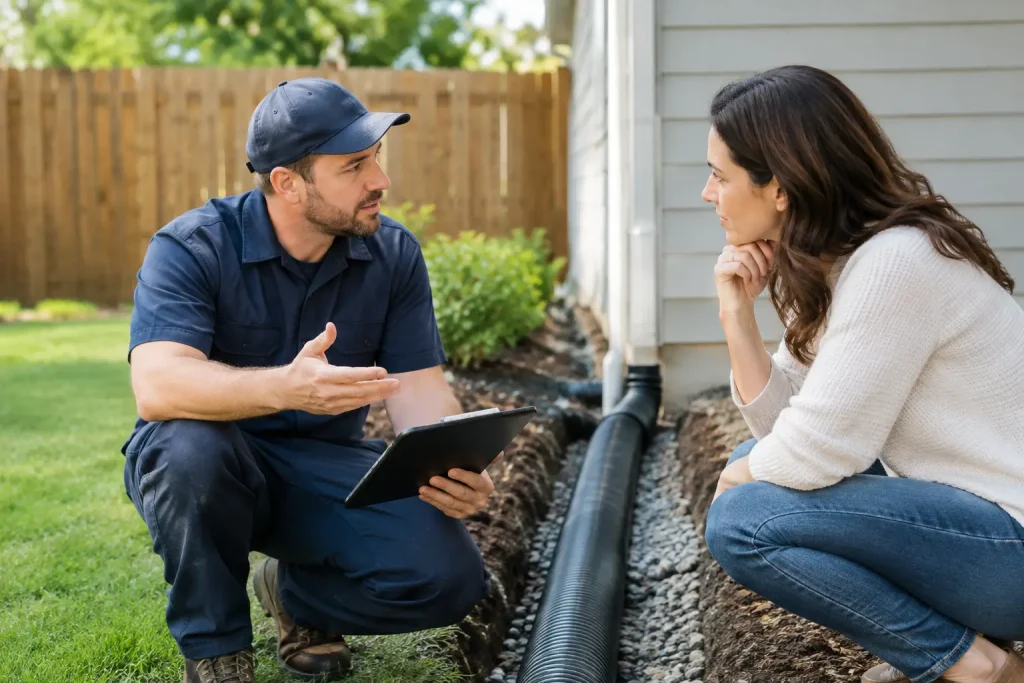
A wet basement rarely starts as a basement problem. Often, the real issue is outside: roof runoff dumping beside the foundation, soil sloping toward the house, clogged underground piping, or groundwater collecting where it has nowhere else to go. The right drainage contractor questions help you identify whether a company understands the source of the water or is simply selling the same system to every homeowner.
A reliable contractor should welcome informed questions. You are making a long-term decision about your home, its air quality, its structure, and its resale value. Clear answers, a careful inspection, and a written plan should come before pressure or promises.
Drainage contractor questions about the inspection
Where is the water coming from?
This is the first question because the answer shapes everything else. Water entering at a basement wall after heavy rain may point to surface grading, overflowing gutters, failed exterior drainage, hydrostatic pressure below the slab, or a combination of conditions. A musty crawl space may have a different cause than standing water near a basement stairwell.
Ask the contractor to explain what they observed and why it supports their recommendation. They should be able to point out the relevant conditions around your property, such as downspout discharge locations, low areas in the yard, cracks, water staining, soil grade, or a nonfunctioning sump pump. If the explanation is vague, ask for more detail before approving work.
Will you inspect both the interior and exterior?
Not every drainage concern requires the same scope of inspection, but a complete evaluation usually looks beyond one visible symptom. Interior signs tell part of the story. Exterior conditions often reveal why the problem keeps returning.
For example, an interior French drain may be the appropriate solution for groundwater pressure under a basement floor. But if roof water is also being directed against the foundation, correcting that condition can reduce the burden on the drainage system. A good contractor explains where one solution ends and another begins.
Is this a drainage issue, a foundation issue, or both?
Water and foundation concerns can overlap, but they are not interchangeable. A hairline crack may be a minor concrete condition. A widening crack, bowing wall, settlement, or persistent water intrusion may require a more specialized assessment and a different repair plan.
Be cautious of anyone who dismisses visible foundation movement without explanation, or who immediately turns every crack into an expensive structural emergency. Homeowners deserve a clear, evidence-based recommendation. No problems, just solutions means addressing what is actually happening at your home.
Questions to ask about the proposed drainage system
What type of system do you recommend and why?
“French drain” is often used as a catch-all term, but drainage systems can be installed inside or outside the foundation and may serve very different purposes. An interior perimeter drainage system generally collects water beneath or alongside the basement floor and directs it to a sump basin. Exterior drains can manage surface and subsurface water around the outside of the home, though access, landscaping, soil conditions, and depth can affect whether they are practical.
Ask the contractor to describe the route water will follow from collection to discharge. You should understand where the drain is placed, how it is protected from sediment, where the sump pump is located if one is needed, and where the water ultimately exits. A system is only as useful as its ability to move collected water safely away from the foundation.
How will the discharge be handled?
This question is especially important in New Jersey, where lot sizes, municipal requirements, winter weather, and neighboring properties can all affect discharge options. A contractor should not leave you guessing whether the system will empty too close to the house, onto a walkway, or into an area that floods every time it rains.
Ask whether the discharge line will be buried, what protects it from freezing or clogging, and how far it will carry water from the foundation. The best approach depends on the property. A good plan accounts for the grade, available outlet locations, local rules, and practical maintenance needs.
What happens during a power outage?
Primary sump pumps need electricity. If the power goes out during a major storm, the very conditions that created the problem may also prevent the pump from operating. Ask whether a battery backup sump pump is recommended, how long it can run, what kind of alarm is included, and what maintenance it requires.
A backup system is not necessary for every home, but it is worth discussing when a basement has valuable finished space, frequent water pressure, or a history of outages. The contractor should present it as a practical option, not use it as a scare tactic.
Drainage contractor questions about installation quality
Who will perform the work?
Ask whether the people installing the system are in-house employees or subcontractors. This matters because drainage work requires consistency, training, accountability, and respect for your home. You should know who is responsible for the installation from the first day of work through final cleanup.
At A-1 Basement Solutions, in-house W2 crews are part of the commitment to quality control and clear responsibility. Regardless of whom you hire, ask how the crew is trained, who supervises the project, and who you should contact if questions come up during installation.
How will you protect my home and clean up afterward?
Interior drainage installation can involve breaking and removing sections of concrete around the basement perimeter. That work should be planned carefully. Ask how dust will be managed, how work areas will be protected, how debris will be removed, and whether the concrete will be restored after the drainage system is installed.
For exterior work, ask about landscaping, hardscaping, utility locating, and access for equipment. Some disturbance may be unavoidable, particularly when excavation is involved. The key is receiving an honest explanation before work starts, not discovering surprises after the crew arrives.
Are permits or utility markings needed?
The answer depends on the scope of work and local requirements. Exterior excavation, electrical work for a sump pump, and discharge changes may involve permits or utility markings. A professional contractor should explain what applies to your project, who will coordinate it, and whether those costs are included in the proposal.
Do not assume permits are unnecessary because a contractor does not mention them. Ask directly. Proper planning protects your property and helps prevent delays.
Questions about cost, warranties, and long-term value
What is included in the written estimate?
A written proposal should describe the work clearly enough that you can compare it with another estimate. Look for the drainage area being addressed, the materials and components included, sump pump details, discharge method, concrete restoration, cleanup, permit responsibilities, and any exclusions.
The lowest price is not automatically the best value. One proposal may include a complete drainage path and reliable discharge while another covers only a short section of drain. Compare the actual scope, not just the total at the bottom of the page.
What warranty is provided, and is it transferable?
Ask what is covered, how long coverage lasts, whether there are conditions or exclusions, and whether the warranty transfers to a future homeowner. A written guarantee can be meaningful, but only when you understand what it applies to and who stands behind it.
For long-term waterproofing work, transferable coverage can add confidence for homeowners who plan to stay for decades as well as those who may sell later. Keep copies of the agreement, installation details, and any maintenance instructions with your home records.
What maintenance will the system need?
No drainage system should be treated as completely maintenance-free. Sump pumps should be tested periodically, discharge lines should remain clear, and gutters and downspouts still need regular attention. If a contractor tells you a system will solve every possible water issue forever without any homeowner upkeep, that is a reason to ask more questions.
Request simple maintenance guidance in writing. You should know what to check, how often to check it, and whom to call if you hear an alarm, notice slow drainage, or see water returning.
Choosing a contractor without the pressure
A trustworthy drainage contractor does not need to rush you into a decision. They should give you time to review the proposal, ask questions, and understand the trade-offs between options. Some homes need an interior drainage system because groundwater pressure cannot be reliably controlled from outside. Others may benefit first from correcting grading, gutters, or discharge problems. Sometimes the durable answer is a combination of improvements.
Pay attention to how the contractor communicates. Are they specific about the cause? Do they explain what they can and cannot promise? Is the scope written clearly? Do they treat your concerns respectfully? Those details are often a better indicator of the experience ahead than a dramatic sales presentation.
The goal is not simply to install a drain. It is to give water a controlled path away from the parts of your home it can damage. Ask the questions, keep the answers in writing, and choose the team that makes you feel informed rather than pressured.