
A basement that smells damp after every storm usually tells you something before you ever see standing water. Maybe the paint is bubbling. Maybe the floor feels humid. Maybe you have one wall that always seems colder or darker than the rest. When homeowners compare interior vs exterior waterproofing, the real question is not which one sounds better. It is which system actually matches how water is getting in and what will protect the home for the long run.
That distinction matters because basement water problems are rarely one-size-fits-all. Some homes need to stop water pressure from building around the foundation. Others need a reliable way to manage water that is already finding its way in. In many cases, the right answer depends on the age of the home, the foundation type, the grading outside, and whether the problem is occasional seepage or a recurring wet-basement issue.
Interior vs exterior waterproofing: what is the difference?
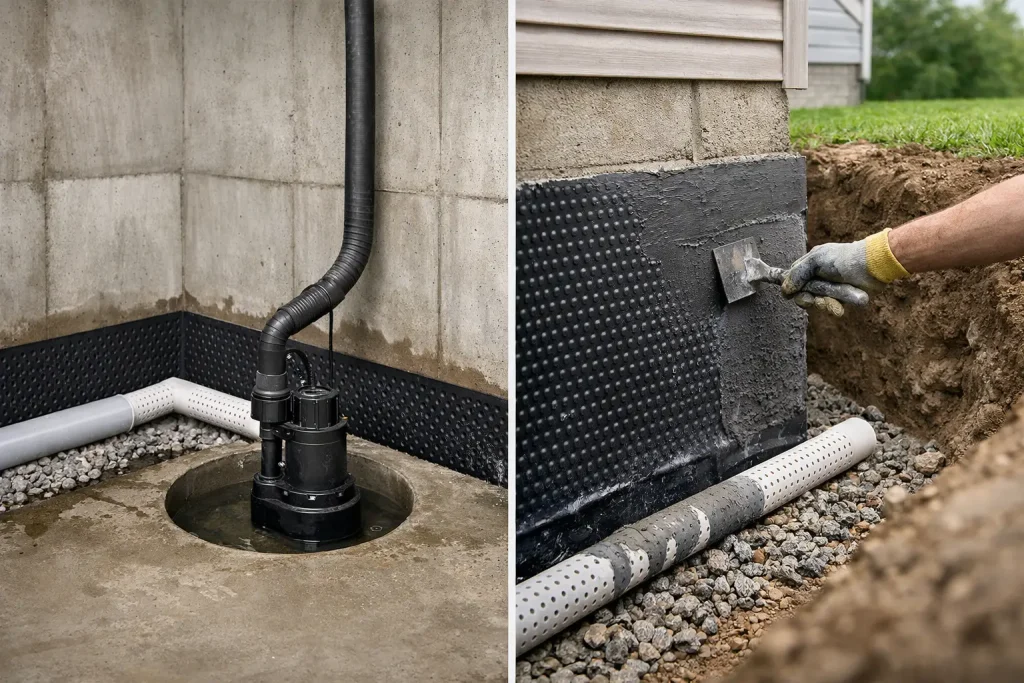
Interior waterproofing manages water from inside the basement or crawl space. Exterior waterproofing works from the outside of the foundation to reduce or block water before it reaches the wall. Both approaches are legitimate. Both can work well. But they solve different parts of the same problem.
Interior systems usually include perimeter drainage installed along the inside edge of the basement floor, a sump pump to collect and discharge water, vapor barriers in some situations, and crack repair where needed. These systems do not usually stop groundwater from touching the foundation wall. Instead, they control it safely and direct it away before it damages the living space.
Exterior waterproofing is more invasive because it typically involves excavation down to the foundation wall. Once exposed, the wall can be cleaned, repaired, coated with waterproofing materials, and paired with exterior drainage such as footing drains. This approach is designed to reduce direct water penetration and hydrostatic pressure against the foundation.
When interior waterproofing makes more sense
For many New Jersey homes, interior waterproofing is the most practical and dependable solution. That is especially true when groundwater is the main issue and the basement takes on seepage during heavy rain or seasonal saturation.
An interior drainage system works with gravity. Water that enters at the cove joint, through porous block walls, or through floor cracks is intercepted and moved to a sump basin, where a pump sends it away from the house. When properly designed, this gives homeowners a controlled path for water instead of letting it collect on the floor or behind finished walls.
It is also often less disruptive than exterior excavation. Landscaped areas, patios, walkways, driveways, decks, and attached structures can make outside access difficult or expensive. Interior work avoids tearing up much of the property. For homeowners who want a lasting fix without rebuilding the yard, that matters.
Interior systems also tend to be the stronger choice when the goal is reliable water management under real-world conditions. If rainwater, rising groundwater, or subsurface drainage issues are overwhelming the foundation area, it can be more realistic to collect and redirect that water than to assume it can always be kept entirely away from the structure.
That said, interior waterproofing is not magic. It does not remove the need for proper gutters, downspout extensions, grading, and exterior drainage improvements. If roof runoff is dumping next to the house, no basement system should be expected to compensate for that forever.
When exterior waterproofing is the better fit
Exterior waterproofing can be the right move when the main concern is direct water entry through foundation walls, deteriorated exterior coatings, or visible structural cracks that need outside access for a proper repair.
If a home has severe lateral water pressure, damaged foundation surfaces, or poor drainage at the footing level, working from the outside addresses the source more directly. This can be especially useful when foundation walls show clear signs of deterioration from long-term moisture exposure.
Exterior work may also be appropriate during major renovations or new construction, when access to the outside of the foundation is already available. In those cases, applying exterior waterproofing membranes and drainage systems can be more efficient than returning later after landscaping and hardscaping are complete.
The trade-off is cost and disruption. Excavation is labor-intensive. It may require removing shrubs, stoops, sidewalks, or portions of a driveway. Soil conditions, depth, access, and nearby utilities all affect complexity. On some properties, it is simply not the most practical way to solve the issue.
There is another point homeowners deserve to hear clearly: exterior waterproofing is not always the complete answer if water is also rising from beneath the slab. If the water problem involves hydrostatic pressure under the basement floor, outside wall treatment alone may not fully protect the interior.
Interior vs exterior waterproofing for older homes
Older homes often need a more careful evaluation because water intrusion is not always coming from a single failure point. Stone foundations, block walls, aging mortar joints, and settlement cracks all change the picture.
In these homes, an interior system is often favored because it manages water consistently even when walls are imperfect or porous. Trying to create a perfect exterior barrier around an older foundation can be difficult, especially if the wall materials are uneven or if access is limited by neighboring structures and mature landscaping.
On the other hand, if an older home has foundation walls that need structural attention from the outside, exterior excavation may be part of a broader repair plan. Waterproofing and foundation repair sometimes need to work together, not as separate decisions.
This is why a quick sales pitch is not enough. A good recommendation should come from an inspection, not a script.
Cost is important, but value matters more
Homeowners naturally ask which option costs less. In many situations, interior waterproofing is less expensive upfront than full exterior excavation. But price by itself can be misleading.
The better question is what the system is meant to do. If a lower-cost interior system solves the actual problem and keeps the basement dry for the long term, that is value. If an expensive exterior project still leaves water pressure under the slab unmanaged, that is not value, even if it sounds more comprehensive.
The same logic works in reverse. If the real problem is a failed exterior wall coating or a buried drain issue that can only be corrected from outside, choosing interior drainage alone may not address everything that needs attention.
Homeowners should also weigh the long-term consequences of delay. A wet basement is not just a nuisance. It can lead to mold growth, damaged finishes, musty air, weakened materials, and reduced confidence in the home itself. Waterproofing is not only about comfort. It is about protecting the structure and the investment.
How to choose the right basement waterproofing approach
The right choice usually comes down to diagnosis. Where is the water entering? Is it coming through the wall, the floor joint, a crack, or several places at once? Does the issue happen only during heavy storms, or is the basement damp even in ordinary weather? Are there exterior drainage defects contributing to the problem?
A trustworthy contractor should walk you through those answers in plain language. You should understand whether the recommendation is designed to block water, manage water, relieve pressure, repair damage, or combine those goals.
In many homes, the best solution is not strictly interior or strictly exterior. It is a combination. For example, a basement may need interior drainage and sump pump protection, plus exterior grading correction and downspout improvements. A crack may need targeted repair while the larger water issue is handled by drainage. Real waterproofing is often layered, because real water problems are layered too.
That is one reason companies like A-1 Basement Solutions focus on solution-first inspections instead of pressure tactics. Homeowners do not need a dramatic sales presentation. They need a clear explanation of what is happening, what will fix it, and what will hold up over time.
The best system is the one that fits the house
There is no honest blanket rule that says interior is always better or exterior is always better. The better system is the one that matches the foundation, the site conditions, and the way water is behaving on that property.
If your basement is taking on water, start with a thorough inspection and a straightforward conversation. Ask what problem is being solved, what trade-offs come with each option, and how the system will perform during the kind of storms your home actually sees. A dry basement starts with the right diagnosis, and peace of mind usually follows from there.