
A basement that smells damp after every storm is not a small annoyance. It is usually the house telling you water has found a path in, and that path rarely closes on its own. The right wet basement repair options depend on where the water is coming from, how often it happens, and whether the problem is surface runoff, hydrostatic pressure, plumbing leaks, or a foundation issue.
Some homeowners hope a coat of waterproof paint or a store-bought dehumidifier will solve it. Those can help with symptoms in very mild cases, but they do not stop outside water from pushing against the foundation or entering through cracks, wall-floor joints, or porous concrete. If the goal is a dry, healthy, usable basement, the repair has to match the cause.
What causes a basement to stay wet?
Before talking about solutions, it helps to understand the problem. A wet basement is not always the result of one dramatic leak. In many New Jersey homes, moisture issues build slowly because several conditions are working together.
Poor exterior grading is a common one. If the soil around the home slopes toward the foundation instead of away from it, rainwater collects where it should not. Clogged or undersized gutters can do the same thing by dumping roof runoff right next to the house. Over time, that water saturates the soil and increases pressure against the foundation walls.
There is also hydrostatic pressure, which is a technical term for a simple problem: groundwater pushes against the basement from the outside. When enough pressure builds, water looks for the easiest opening. That might be a wall crack, a cove joint where the wall meets the floor, or even the concrete itself.
Sometimes the issue is more localized. A single foundation crack, a failed window well, or a plumbing leak can create recurring moisture in one area. In older homes, it is not unusual to see a combination of all of the above.
Wet basement repair options for different water problems
There is no one-size-fits-all fix. The best wet basement repair options are chosen after a full inspection, not a sales pitch. Here is how the most effective solutions usually break down.
Interior drainage systems
If water is entering at the wall-floor joint or building up under the slab, an interior drainage system is often the most reliable answer. This system is installed along the perimeter of the basement floor to collect incoming water and direct it to a sump pump.
For many homes, this is the workhorse solution because it manages water before it spreads across the basement. It does not stop the ground from getting wet outside, but it controls what happens once water reaches the foundation. That distinction matters. In high-water-table areas or homes with persistent groundwater pressure, managing the water is often more realistic and more dependable than trying to block every drop from the outside.
Sump pump installation
A drainage system needs somewhere to send the water, and that is where a sump pump comes in. The pump collects water in a basin and discharges it safely away from the home.
A good sump pump system is not just about the pump itself. The basin, check valve, discharge line, and backup protection all matter. If your basement only gets damp once every few years, a basic setup may be enough. If flooding happens during heavy storms or power outages, battery backup becomes much more important. A pump that cannot run when the electricity goes out is a weak point in the system.
Foundation crack repair
When water is entering through a visible crack, targeted crack repair may be the right fix. This is especially true when the rest of the basement is dry and the problem is isolated.
Not all cracks mean the same thing. Some are minor shrinkage cracks. Others can point to movement or structural stress. A proper repair seals the water entry point, but a responsible contractor should also tell you whether the crack appears cosmetic or whether it suggests a larger foundation concern. Sealing a crack without addressing ongoing movement can turn a repair into a short-term patch.
Exterior grading and downspout corrections
Sometimes the basement problem starts above ground. If roof runoff is pouring beside the house or the landscaping pitches water toward the foundation, fixing the drainage pattern can make a major difference.
This can involve regrading soil, extending downspouts, correcting low spots, or reducing water concentration near the foundation. These repairs are often less invasive than interior waterproofing, but they work best when surface water is the main issue. If groundwater pressure is already a factor, exterior drainage improvements may help but not fully solve the problem.
Exterior waterproofing
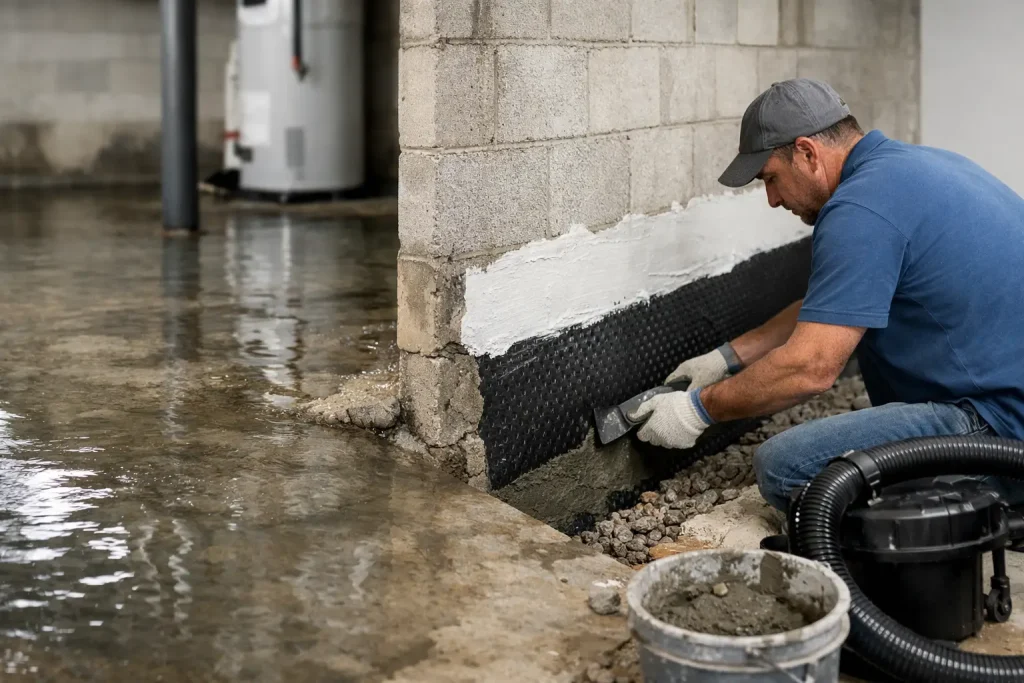
Exterior waterproofing addresses the problem from the outside by excavating around the foundation, applying waterproof membranes or coatings, and improving drainage at the wall.
This can be a strong solution in certain situations, especially when foundation walls are deteriorating, exterior cracks are accessible, or major renovation work is already underway. But it is also more disruptive and typically more expensive than interior systems. That does not make it wrong. It just means the home has to justify that level of work.
Dehumidification and mold control
A dehumidifier is not a waterproofing system, but it can be an important part of the overall solution. Once water intrusion has been addressed, controlling humidity helps protect air quality, stored belongings, and finished spaces.
If a basement has had chronic moisture, mold remediation may also be needed. This is especially important when there is visible growth, musty odor, or concern about indoor air conditions. Drying the basement without addressing contamination can leave the space cleaner-looking but still unhealthy.
Which repair option is best?
The honest answer is that it depends on the pattern of water. If the problem shows up along the perimeter after storms, an interior drain and sump pump system is often the most dependable route. If one wall has a single leak and the rest of the basement stays dry, crack repair may be enough. If water is obviously dumping near the house because of bad grading or short downspouts, start there.
What homeowners want to avoid is paying for the wrong level of repair. An undersized solution usually leads to repeat problems. An oversized solution can mean spending more than necessary. The right recommendation should explain what is happening, why it is happening, and what level of repair actually fits the house.
Signs you may need more than a simple waterproofing fix
Some wet basement problems overlap with structural concerns. Bowing walls, widening cracks, uneven floors, and doors that no longer close properly deserve a closer look. Water is often part of that story, but not the whole story.
In those cases, basement waterproofing and foundation repair may need to work together. Keeping water out is critical, but if pressure has already affected the wall, drainage alone may not be enough. This is where an inspection from a specialist matters. Homeowners should not be left guessing whether they are dealing with moisture, structural movement, or both.
What to expect from a professional inspection
A good inspection should feel educational, not high pressure. The contractor should look at the basement, the exterior drainage conditions, foundation walls, discharge points, and any signs of mold or structural stress. They should also ask when the problem occurs – after heavy rain, during snowmelt, all year, or only in one corner.
You should come away with a clear explanation of the repair options, the trade-offs, and the expected outcome. If a simpler correction will solve the problem, that should be said plainly. If a full perimeter system is the better long-term investment, that should be explained just as clearly.
For many homeowners, trust matters as much as the repair itself. A company that uses trained in-house crews, communicates clearly, and stands behind its work gives you a lot more confidence than one that treats your basement like a quick sales opportunity. That is one reason homeowners call A-1 Basement Solutions when they want direct answers and lasting protection.
The real goal is not just a dry floor
A dry basement is about more than comfort. It protects the structure, reduces the risk of mold, preserves storage and finished spaces, and helps maintain the value of the home. The best repair is the one that solves the actual problem and keeps solving it through the next storm, the next season, and the next year.
If your basement has been wet more than once, do not wait for the damage to become obvious. Water problems tend to get more expensive when they are ignored. A careful inspection and an honest recommendation can turn a frustrating issue into a fix you can stop worrying about.