
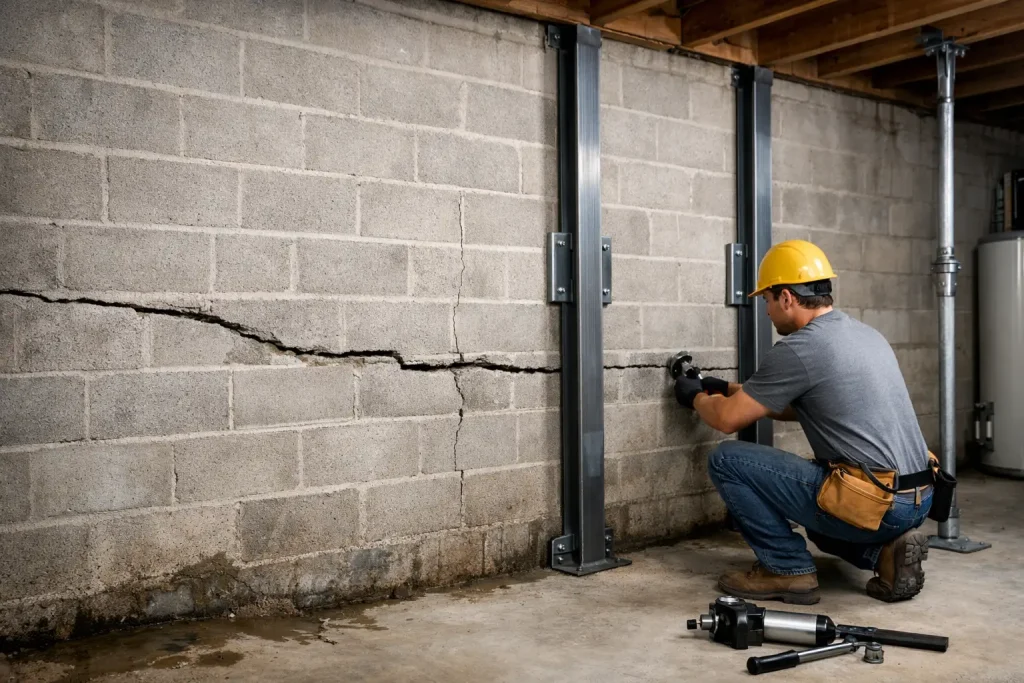
A basement wall rarely bows all at once. More often, homeowners notice small signs first – a horizontal crack, a wall that looks slightly pushed inward, doors above that feel off, or moisture showing up where it never used to. Bowing basement wall repair becomes the right conversation when those signs point to outside pressure forcing a foundation wall out of position, and the sooner that movement is evaluated, the more options you usually have.
What a bowing wall is really telling you
A bowing basement wall is not just a cosmetic issue. It usually means the wall is carrying more lateral pressure than it was designed to handle. In New Jersey, that pressure often comes from saturated soil, poor exterior drainage, freeze-thaw cycles, expansive clay content, or backfill that holds too much water against the foundation.
When soil outside the home becomes heavy and waterlogged, it presses inward on the basement wall. Over time, that constant force can cause a block wall or poured concrete wall to lean, crack, or bulge. Sometimes the movement is slow and steady over years. Sometimes a particularly wet season makes an existing problem worsen faster.
That is why a bowed wall should never be treated as a wait-and-see issue. The wall may still be standing, but the movement is evidence that the structure is under stress.
Common signs you may need bowing basement wall repair
Most homeowners are not checking their basement walls with a level every month, so the warning signs tend to be practical ones. You may notice a long horizontal crack in a block wall, stair-step cracking along mortar joints, inward movement in the middle of the wall, or separation where the wall meets the floor joists above.
Water intrusion is also common. A wall under pressure often develops cracks or joint openings that let moisture in. If your basement smells damp, has recurring seepage, or shows white mineral staining on the wall surface, those signs may be connected to the same underlying pressure problem.
In more advanced cases, the wall can tilt enough to affect the framing above it. Floors may feel uneven, interior cracks may appear upstairs, or windows and doors may stop operating normally. At that stage, the problem is no longer isolated to the basement.
Why walls bow in the first place
The most common cause is hydrostatic pressure – water in the soil building force against the wall. But the real answer is usually a combination of factors, not one single failure.
Poor grading can direct roof runoff toward the house instead of away from it. Clogged or short downspouts can dump large volumes of water right at the foundation line. Some properties also have older perimeter drainage systems that no longer relieve water effectively. Add in seasonal soil expansion and contraction, and the wall may be dealing with repeated cycles of loading and stress.
The wall type matters too. Concrete block walls are especially vulnerable because the hollow cores and mortar joints can be weaker under sustained lateral pressure than a well-reinforced poured concrete wall. That does not mean poured walls cannot bow – they can – but the repair approach may differ.
Bowing basement wall repair is not one-size-fits-all
One of the biggest mistakes homeowners make is assuming there is a single “best” fix. There is not. The right repair depends on how far the wall has moved, what material it is made from, whether the movement is still active, and how much access exists inside or outside the home.
That is why a proper inspection matters. A contractor should look at the amount of deflection, crack patterns, moisture conditions, drainage issues, and whether the wall can be stabilized in place or needs partial or full rebuilding. If someone jumps straight to the most expensive option without explaining why, that is a red flag.
A good repair plan should address two things at the same time: structural stabilization and pressure reduction. If you only brace the wall but ignore the water and soil conditions causing the pressure, you may still be dealing with ongoing stress around the foundation.
The most common repair options
Wall anchors
Wall anchors are often used when there is enough yard space outside the home to install anchor plates in stable soil away from the foundation. A steel rod connects the exterior anchor to an interior wall plate, and the system is tightened to stabilize the wall. In many cases, anchors can also allow for gradual straightening over time.
This is a strong option for many bowing block walls, but it depends on exterior access. Patios, driveways, property lines, and underground utilities can limit whether anchors are practical.
Steel I-beams
Steel beams installed vertically against the inside of the wall are another common stabilization method. They brace the wall and resist further inward movement. This can be a good fit when exterior excavation is not ideal or when the goal is to stop movement without major disruption to the yard.
The trade-off is that beams generally stabilize more than they straighten. They can be very effective, but the best use depends on how severe the bowing is and whether the wall is still structurally sound enough to remain in place.
Carbon fiber straps
Carbon fiber reinforcement can work for walls with early-stage inward movement, especially when the deflection is limited and the wall has not significantly shifted out of plane. These straps bond to the wall surface and help prevent further movement.
They are less invasive and maintain usable basement space, but they are not for heavily bowed walls. If a wall has already moved substantially, carbon fiber may not provide the level of correction or reinforcement needed.
Rebuilding or replacing the wall
When movement is severe, cracking is extensive, or the wall has lost too much structural integrity, rebuilding may be the safest path. That can mean partial replacement or full wall reconstruction, depending on conditions.
This is usually the most involved option, but sometimes it is the only responsible one. A trustworthy contractor should say that plainly when needed, not avoid the hard answer.
Water control is part of the repair
A wall bows because of pressure. Pressure usually gets worse when water is not being controlled correctly. That is why structural repair and waterproofing often go hand in hand.
Exterior grading corrections, downspout extensions, drainage improvements, sump pump systems, and interior waterproofing can all play a role depending on the property. The exact combination depends on where water is coming from and how it is moving around the foundation.
For homeowners, this matters because the cheapest structural fix is not always the best value. If the wall is stabilized but the basement still takes on water and the soil outside stays saturated, the home may continue facing avoidable risk.
How to know when it is urgent
Any inward wall movement is worth evaluating, but some signs call for faster action. If the bowing appears to be increasing, if a horizontal crack is widening, if the wall is bulging noticeably in the center, or if you see water entering through fresh cracks, do not put it off.
The same goes for walls with visible displacement at the top or bottom, loose blocks, or signs that floor framing above is being affected. Those conditions suggest the problem may be advancing beyond a simple stabilization job.
You do not need to panic, but you do need a clear answer. The right inspection should tell you how serious the movement is, whether it is active, and what repair options make sense for your home and budget.
What homeowners should expect from a contractor
This kind of repair requires honesty. You should expect a contractor to explain what caused the wall to move, how much it has moved, whether the goal is stabilization or correction, and what supporting water-management work may be recommended.
You should also expect clear communication about trade-offs. Some systems are less invasive. Some offer better long-term correction. Some cost more up front but address the full issue more completely. The right company will walk you through those differences without pressure.
At A-1 Basement Solutions, that solutions-first approach matters because homeowners need clarity, not scare tactics. A bowed basement wall is serious, but it is also repairable when the problem is diagnosed correctly and addressed with the right system.
A basement wall does not have to fail completely to deserve attention. If something looks off, trust that instinct and have it evaluated. Catching movement early can protect your home, expand your repair options, and give you a much better path to long-term peace of mind.