
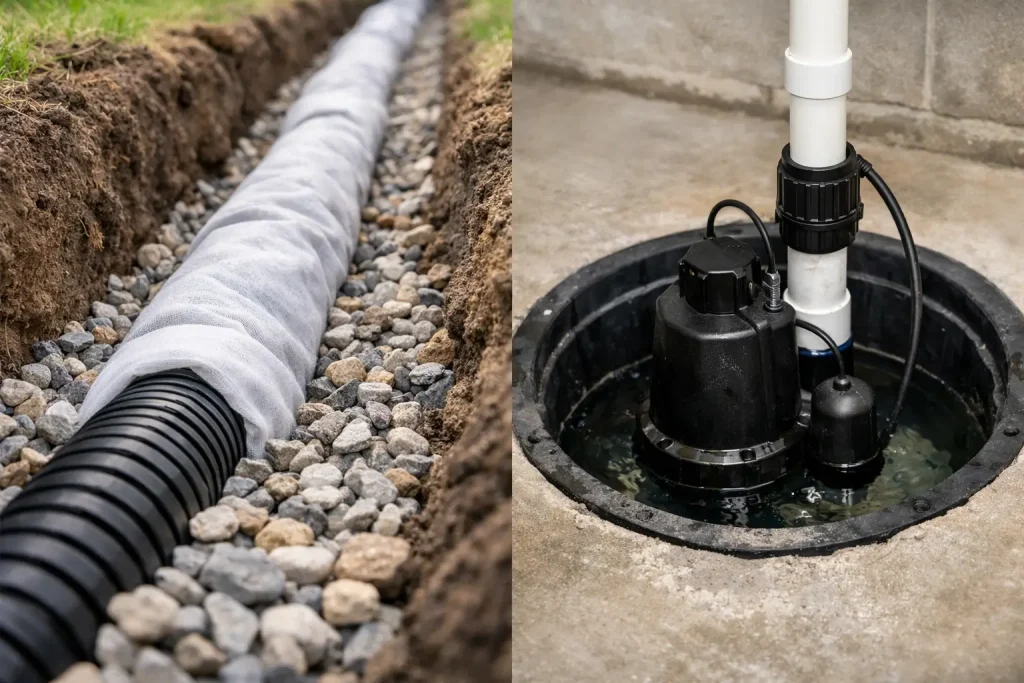
A wet basement usually does not start with a dramatic flood. More often, it starts with a damp wall after heavy rain, a musty smell that never quite goes away, or water showing up in the same corner every spring. When homeowners compare french drain vs sump pump options, they are usually trying to answer one real question: what will actually keep this basement dry for the long haul?
The short answer is that these systems do different jobs. A French drain collects and redirects water before it can build up where it should not. A sump pump removes water that has already been collected and sends it away from the home. In many basements, the best answer is not one or the other. It is both, installed as part of a complete waterproofing plan.
French drain vs sump pump: the basic difference
A French drain is a drainage system designed to manage groundwater. In basement waterproofing, it is often installed around the interior perimeter of the basement floor or, in some cases, outside the foundation. Its job is to capture water that is pressing against the foundation and guide it to a controlled drainage point.
A sump pump sits inside a sump basin, usually at the lowest point of the basement drainage system. When water enters that basin and rises to a certain level, the pump turns on and pushes the water out through a discharge line to a safer area away from the house.
That distinction matters. A French drain is passive. It collects and channels water. A sump pump is active. It mechanically removes that water from the house.
If you picture water pressure building around your foundation during a storm, the French drain relieves the pressure by giving the water somewhere to go. The sump pump finishes the job by moving that collected water out and away.
What a French drain does well
A properly designed French drain is excellent at handling water that enters around the perimeter of a basement or builds up in the soil around the foundation. That makes it especially useful for homes with hydrostatic pressure, recurring seepage at the cove joint where the wall meets the floor, or dampness after extended rainfall.
Because it works along the path where water naturally travels, a French drain can reduce the chance of standing water on the basement floor. It also helps protect finished spaces, stored belongings, and lower wall sections from repeated moisture exposure.
Another advantage is that it addresses the problem closer to the source. Instead of waiting for water to spread across the floor, the system intercepts it at the edge of the basement and directs it into the drainage channel.
That said, a French drain by itself is not always enough. If water is collected but not removed effectively, it still needs an exit point. In many interior systems, that exit point is the sump basin.
What a sump pump does well
A sump pump is the workhorse of a basement waterproofing system. It is built to remove collected water quickly, especially during heavy storms or fast snowmelt. If your basement takes on water during intense weather, or if your property has a high water table, the pump may be the most visible and critical line of defense.
It is also the system homeowners notice most. You hear it switch on. You see the discharge outside. You know it is doing something.
A sump pump is especially valuable when water volume can rise quickly. In those situations, drainage alone is not enough. Water has to be moved out fast and reliably. A quality pump system, installed correctly and sized for the home, can make the difference between a dry basement and a cleanup project.
But a sump pump has limits too. On its own, it does not solve every water issue. If water is entering across a wide perimeter and there is no proper drainage path leading to the sump pit, the pump may only address part of the problem.
When a French drain is the better choice
If your basement shows signs of consistent seepage along the perimeter, a French drain is often the right foundation of the solution. This is common in older New Jersey homes, homes with poor exterior grading, and houses where groundwater builds up around the footing after storms.
You may benefit from a French drain if you notice water at the wall-floor joint, damp basement edges, mineral deposits on walls, or recurring moisture that does not seem tied to one plumbing source. These clues point to groundwater pressure, not just an isolated leak.
A drain system is also useful when the goal is broader moisture control rather than emergency pumping alone. By collecting water along the basement perimeter, it helps manage the conditions that contribute to mildew, musty odors, and long-term material damage.
When a sump pump is the better choice
If your main issue is water accumulation at a low point, or if your home already has a drainage system that needs a reliable discharge method, a sump pump may be the priority. This is also true for homes in areas with frequent heavy rains, high groundwater, or a history of sudden basement flooding.
A sump pump becomes especially important when timing matters. If water can rise quickly, you need active removal, not just collection. Homeowners who have experienced storm-related flooding often need a stronger pumping solution, sometimes with battery backup protection in case the power goes out during severe weather.
In short, if water is getting in fast or building up in volume, a sump pump is often essential.
Why many homes need both
The most effective waterproofing systems are often built around both drainage and pumping. This is where the french drain vs sump pump debate can be misleading. It suggests a choice between two competing systems when, in practice, they are frequently partners.
The French drain captures the water before it reaches the usable area of the basement. The sump pump removes that collected water from the home. One manages the flow. The other completes the removal.
That combination is often the best fit for homes with chronic basement moisture, seasonal water intrusion, or repeated seepage during storms. It is also the more dependable setup when you want long-term protection rather than a short-term patch.
For homeowners, this matters because basement water problems rarely come from a single cause. You may have groundwater pressure, minor wall seepage, exterior drainage issues, and storm-related water volume all at once. A system that addresses only one piece can leave you with repeat problems.
What affects the right choice for your home
The right solution depends on how water is entering, how much water is involved, and what conditions surround the home. The age of the house matters. The soil around the foundation matters. The basement layout matters. Even whether the space is unfinished storage or a finished family room changes the level of protection you may want.
A home with occasional dampness may need a different system than a home with standing water after every storm. A basement with foundation wall seepage may point toward perimeter drainage. A basement with an existing drain and no effective discharge may point toward pump replacement or upgrade.
This is why honest inspection matters more than guesswork. A good waterproofing recommendation should not start with a one-size-fits-all sales pitch. It should start with identifying where the water is coming from and what conditions are allowing it to become a problem.
Installation quality matters as much as the system
Even the right system can disappoint if it is installed poorly. A French drain has to be pitched correctly, placed where it can actually intercept water, and integrated properly with the rest of the waterproofing plan. A sump pump has to be sized correctly, set in a proper basin, and discharged to an appropriate location away from the foundation.
Clean workmanship matters too. So does clear communication about what is being installed and why. Homeowners should know whether they are getting a partial fix for one symptom or a more complete system designed for long-term protection.
That is one reason many homeowners prefer working with specialists like A-1 Basement Solutions. When the crew, installation process, and warranty all come from the same company, there is more accountability and less confusion.
The better question to ask
Instead of asking whether a French drain or sump pump is better, ask what combination of drainage and water removal your basement actually needs. That leads to a better answer and usually a better result.
Some homes need only one system. Many need both. The goal is not to install more than necessary. It is to solve the water problem completely, with a system that fits the house and gives you confidence every time it rains.
If your basement has been giving you warning signs, trust those signs early. Water problems are usually cheaper, cleaner, and easier to solve before they turn into damaged walls, ruined flooring, or mold concerns. A dry basement is not about luck. It is about having the right system in the right place, for the right reason.