
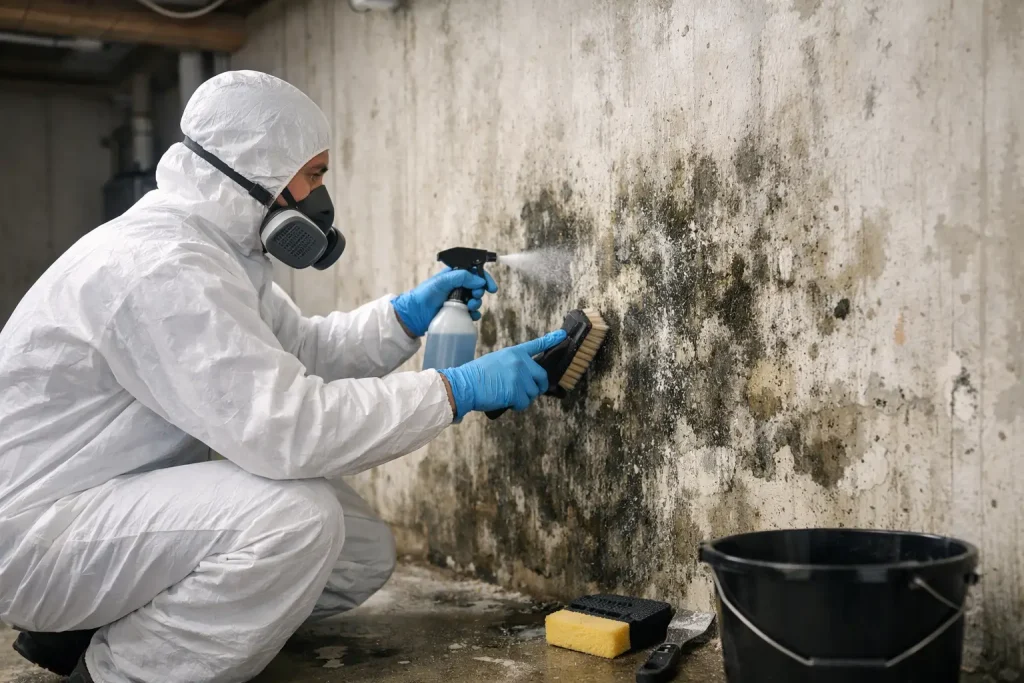
That musty smell in a basement usually means one thing – moisture has been winning for a while. If you are searching for how to remove basement mold, the first thing to know is that cleaning the surface is only part of the job. If the basement is still damp, humid, or taking on water, mold will keep coming back no matter how hard you scrub.
Basement mold is common in New Jersey homes because below-grade spaces naturally hold moisture. Add a small leak, poor drainage, high humidity, or a past flood, and mold has everything it needs to grow. The good news is that some mold problems can be handled safely by a homeowner. Others need professional remediation and waterproofing to fix the cause, not just the symptom.
How to remove basement mold safely
Before you clean anything, take a step back and look at the size of the problem. A small patch on a non-porous surface is very different from widespread growth on drywall, insulation, or wood framing. If the mold covers a large area, keeps returning, or appeared after sewage backup or major flooding, this is usually not a do-it-yourself project.
For smaller areas, safety comes first. Wear gloves, eye protection, and an N95 mask or better. Open windows if conditions allow, and avoid running fans that can spread spores through the house unless the area is properly contained. If your basement connects directly to finished living space, be especially careful about disturbing mold without controlling where those spores go.
The next step is to identify what the mold is growing on. Non-porous and semi-porous materials like concrete, metal, and some hard plastics can often be cleaned. Porous materials such as carpet, ceiling tiles, insulation, and drywall usually cannot be fully salvaged once mold has penetrated them. In those cases, removal and replacement are often the more reliable choice.
When cleaning a hard surface, start by lightly dampening the area to reduce airborne dust and spores. Scrub with a mold-cleaning solution or detergent and water. Bleach gets a lot of attention, but it is not always the best answer in basements. It may disinfect the surface, but it does not solve the underlying moisture issue, and on porous materials it often does not reach deep enough to stop growth. The goal is to physically remove the mold and then dry the area completely.
After cleaning, dry the space as quickly as possible. Use a dehumidifier, and if the source of moisture is still active, address that immediately. If the basement still feels humid, smells musty, or shows water staining, the cleanup is incomplete even if the visible mold is gone.
When mold cleanup should not be DIY
Some situations call for professional help right away. If the mold covers more than a small isolated area, if anyone in the home has asthma or a compromised immune system, or if the basement has recurring water intrusion, it makes sense to bring in a specialist. The same goes for mold inside wall cavities, behind finished basement materials, or around HVAC components.
This is where homeowners can lose time and money by treating the wrong problem. You may remove visible mold from a basement wall, only to find that the real issue is water entering at the cove joint, hydrostatic pressure under the floor, a failed sump pump, or exterior grading that directs water toward the foundation. In that case, remediation without moisture control is temporary.
A good contractor should explain that clearly. Fear-based sales tactics do not help anyone. What matters is finding out where the moisture is coming from and fixing it in a way that lasts.
What causes basement mold in the first place
Mold needs moisture, organic material, and time. Basements give it all three. Wood framing, stored cardboard boxes, drywall paper, and dust can all feed growth once humidity rises or water gets in.
In many homes, the source is not dramatic. It may be condensation on cold walls or pipes, high summer humidity, a minor foundation crack, or water seepage after heavy rain. In other homes, it is tied to larger drainage failures, such as clogged footing drains, poor gutter discharge, or basement walls exposed to long-term moisture pressure from the surrounding soil.
That is why two basements with the same mold stain may need completely different solutions. One may improve with better ventilation and dehumidification. Another may need interior drainage, sump pump work, crack repair, or full waterproofing.
How to remove basement mold and keep it from returning
The cleaning step matters, but the prevention step is what protects your home. If you want to know how to remove basement mold for good, think beyond the stain you can see.
Start with humidity. A basement should generally stay below 50 percent relative humidity. If it feels damp in summer, a properly sized dehumidifier is often one of the simplest and most effective tools. Emptying it manually every day is not a long-term plan, so if possible, set it up to drain automatically.
Next, look for water entry. Check the wall-floor joint, around windows, near cracks, and in corners where water tends to collect. Efflorescence, staining, peeling paint, and musty odors are all signs that moisture has been present, even if you do not see standing water now.
Your drainage outside matters too. Downspouts should discharge far enough from the house, grading should slope away from the foundation, and low spots near the home should be corrected. These fixes can help, but they are not always enough when the problem is below grade and pressure is pushing water toward the basement.
If the basement has repeated seepage or flooding, a waterproofing system may be the real answer. That can include interior French drains, sump pump installation, vapor barriers, crawl space protection, or foundation repair depending on what the inspection shows. The right solution depends on how water is entering and how often it happens.
Materials that usually need to be removed
Homeowners often ask whether everything can just be cleaned. Sometimes it can, but not always. Mold on painted concrete is very different from mold inside finished basement materials.
Drywall, insulation, carpet padding, and cardboard boxes usually need to be discarded if mold growth is significant. Wood can be a gray area. Surface mold on structural wood may be cleanable if the wood is still sound and the moisture problem is corrected quickly. But if wood is soft, decayed, or repeatedly wet, replacement may be necessary.
Stored items also matter. Fabric, paper, and upholstered furniture can hold odor and spores even after the area looks cleaner. If the basement is used for storage, part of the fix may simply be changing what is kept there and how it is stored. Plastic bins with tight lids are safer than cardboard in a damp space.
Signs the problem is bigger than it looks
A small visible patch can hide a larger moisture issue. If you notice mold returning in the same spot, bubbling paint, warped trim, rust on metal surfaces, or a strong musty smell that never really goes away, there is usually more going on than a simple cleaning issue.
Finished basements can be especially deceptive. Water can sit behind walls or under flooring long before it becomes obvious. By the time mold appears in the open, the hidden area may already be extensive. That is one reason professional inspection has value – not to oversell the job, but to determine whether the visible mold is the whole story.
For homeowners who want a lasting fix, the best approach is usually straightforward: remove damaged materials where needed, clean salvageable surfaces properly, dry the area fully, and correct the moisture source. Companies like A-1 Basement Solutions focus on that full-picture approach because a dry basement is what keeps the air healthier and the structure better protected over time.
A practical next step for homeowners
If the mold is small and clearly tied to a one-time issue, careful cleanup and better humidity control may be enough. If the basement smells damp after rain, shows signs of seepage, or has had water problems before, treat mold as a warning sign rather than a cleaning chore.
Basements rarely get better on their own. A little mold today can point to a drainage or waterproofing issue that becomes more expensive later. The most helpful step is not rushing to spray chemicals on everything. It is figuring out why the space is staying wet and dealing with that cause while the problem is still manageable.
A clean basement matters, but a dry basement is what gives you real peace of mind.