
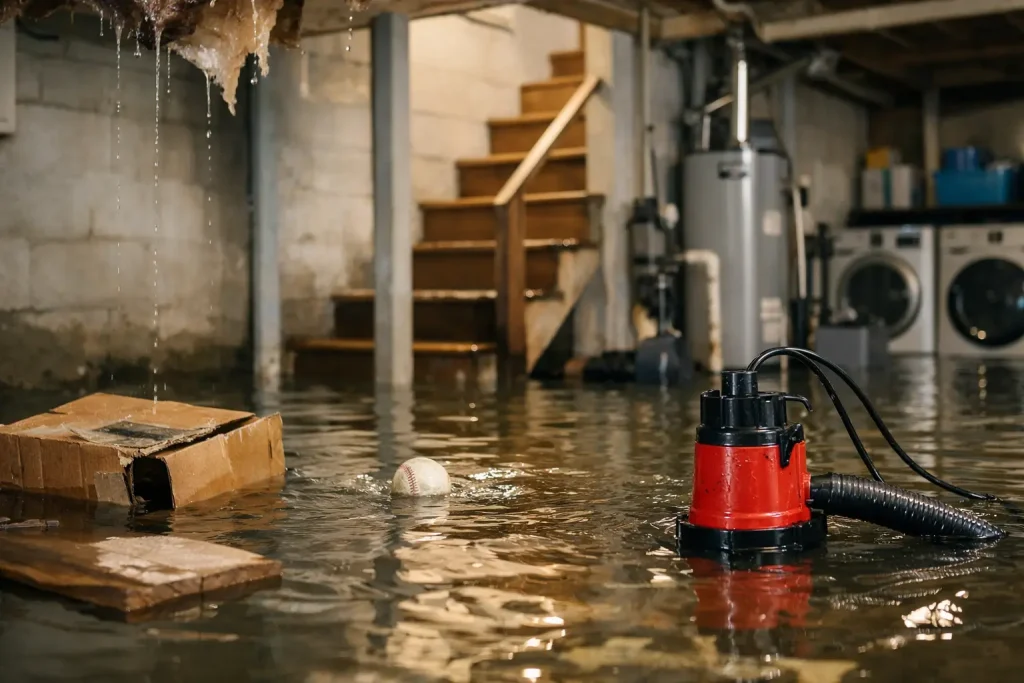
A basement rarely floods without leaving clues first. A damp corner after heavy rain, a musty smell near a finished wall, white mineral marks on concrete, or a sump pump that runs too often can all point to a larger moisture problem. Understanding basement flooding causes helps New Jersey homeowners act before a small water issue turns into damaged belongings, mold growth, or foundation concerns.
The right repair depends on where the water is coming from and how it moves around the home. A wet basement is not always caused by a foundation crack, and a new sump pump alone cannot solve a drainage problem outside. A careful inspection should identify the source, explain the options clearly, and focus on a solution that lasts.
The Most Common Basement Flooding Causes
Poor grading around the foundation
The soil around a home should slope away from the foundation so rainwater moves into the yard instead of collecting against the basement walls. Over time, settling soil, landscaping changes, and erosion can create low areas along the house. When a strong New Jersey rainstorm hits, that water may sit near the foundation and build pressure against below-grade walls.
This is especially common where mulch beds, patios, walkways, or added topsoil have changed the original grade. Homeowners may notice puddles that linger near the house, dampness in the same basement area after storms, or water entering where the wall meets the floor.
Correcting grading can be a practical part of the solution, but it is not always enough by itself. If the home has ongoing groundwater pressure or an aging drainage system, interior waterproofing may also be needed to manage the water safely.
Clogged, damaged, or poorly placed gutters and downspouts
A roof sheds a surprising amount of water during a storm. Gutters and downspouts are meant to collect that water and discharge it well away from the foundation. When gutters overflow, downspouts are clogged, or discharge lines empty right beside the house, the roof runoff gets deposited exactly where it can do the most harm.
Look for overflowing gutters, water pouring over the edge of the roofline, washed-out mulch, or downspouts that end within a few feet of the foundation. Underground downspout lines can also become blocked, crushed, or disconnected without being obvious from above.
Keeping gutters clean and directing downspouts away from the home is basic maintenance with real value. Still, if water continues to enter after those corrections, the basement likely needs a more complete drainage evaluation.
High groundwater and hydrostatic pressure
Some basement flooding causes begin below the surface. After prolonged rain, snowmelt, or seasonal shifts in the water table, groundwater can rise in the soil around the foundation. As that water builds up, it creates hydrostatic pressure – pressure that pushes against basement walls and floors.
Concrete is strong, but it is not designed to remain perfectly waterproof under constant water pressure. Groundwater can find its way through hairline cracks, porous concrete, floor-wall joints, utility openings, and gaps around plumbing penetrations. In some homes, the water may come up through the basement floor rather than through a visible wall crack.
This is why a basement may flood even when the yard appears to drain reasonably well. Exterior water management matters, but homes with recurring groundwater intrusion often benefit from an interior drainage system that relieves pressure and directs water to a properly sized sump pump.
Failed footing drains or exterior drainage systems
Many homes have drainage systems around the footing that were intended to collect groundwater before it reaches the basement. These systems can clog with sediment, fill with roots, collapse, or simply become less effective as a home ages. In older New Jersey homes, the original drainage may be incomplete or no longer functioning as intended.
A failing footing drain often creates a predictable pattern: water enters during heavy or extended rain, usually along one wall or in one section of the basement. The issue may worsen over several seasons as soil conditions and drainage performance change.
Repairing or replacing exterior drainage can involve excavation and may make sense in specific situations. However, it is not automatically the best choice for every property. An interior French drain system can often provide dependable water control with less disruption to landscaping, patios, and driveways. The best approach depends on the home’s construction, access, water source, and long-term goals.
Sump pump problems
A sump pump is a critical line of defense for basements that collect groundwater. But it only works when the pump, basin, discharge line, check valve, and power supply are all doing their jobs. A pump that is undersized, worn out, improperly installed, or blocked by debris may fail during the exact storm when it is needed most.
Power outages are another concern. Severe weather can knock out power while groundwater continues to rise. A battery backup system can provide added protection, though its capacity depends on the battery condition, pump demand, and length of the outage.
Warning signs include a pump that runs constantly, makes unusual noises, cycles on and off rapidly, or does not activate when water enters the pit. A dry-looking sump pit is not always good news either – it may indicate that water is not reaching the basin because the drainage system is clogged or missing.
Foundation cracks and openings around the home
Not every foundation crack causes flooding, but cracks can provide a direct path for water when the surrounding soil is saturated. Vertical cracks are often related to normal settling, while horizontal cracks, stair-step cracks in block walls, or bowing walls can signal more serious pressure or structural movement.
Water can also enter through basement windows, window wells, exterior stairwells, bulkhead doors, utility penetrations, and gaps where additions meet the original structure. A window well without proper drainage can fill like a bucket during a storm, allowing water to press against the window and find its way inside.
Crack repair may be appropriate when a specific crack is the clear entry point. But sealing a crack without addressing the water pressure outside can lead to water finding another weak spot. Good waterproofing looks at both the opening and the reason water is being forced toward it.
How to Tell Where the Water Is Coming From
The timing and location of water can offer useful clues. Water that appears only during heavy rain may point to surface runoff, grading issues, clogged gutters, or window wells. Water that shows up after several days of rain, or rises through the floor, is more often connected to groundwater and hydrostatic pressure.
If the basement is wet near a single pipe, window, or crack, that opening deserves attention. If dampness appears along multiple walls or at the floor-wall joint, the problem may be broader than one visible defect. A musty odor, peeling paint, rusted metal, warped baseboards, and white chalky deposits are all signs that moisture may have been present longer than expected.
Do not assume that a dry basement between storms means the issue is gone. Intermittent water intrusion can still create mold conditions and slowly damage finished materials. Taking photos during or immediately after a storm can help document where water begins and how it travels.
Why Quick Patches Often Do Not Hold Up
Waterproof paint, caulk, and store-bought sealers can be useful for small, isolated maintenance items, but they are rarely a complete answer to recurring water intrusion. When water pressure is pushing from the outside, a surface coating on the inside is being asked to hold back a force it was not designed to manage.
The same is true of relying only on a dehumidifier. A dehumidifier can improve humidity and make a basement more comfortable, but it does not stop liquid water from entering the foundation. It treats the air after the moisture problem has already started.
A lasting repair begins with an honest diagnosis. That may involve improving exterior drainage, repairing a specific opening, installing an interior French drain and sump system, or combining several measures. There is no benefit in recommending more work than a home needs, but there is also no value in selling a short-term patch for a recurring problem.
When to Schedule a Professional Inspection
A one-time puddle caused by an open window or a clearly blocked gutter may have a simple fix. Repeated water, visible foundation movement, moldy odors, or a sump pump that cannot keep up are reasons to have the basement evaluated. The sooner the source is identified, the more options a homeowner usually has before damage spreads.
A-1 Basement Solutions approaches these inspections with a solutions-first mindset: explain what is happening, identify what is necessary, and recommend repairs that fit the home. No problems, just solutions.
A dry, healthy basement protects more than storage space. It protects the air your family breathes, the structure beneath your home, and the confidence that the next heavy rain will stay where it belongs – outside.