
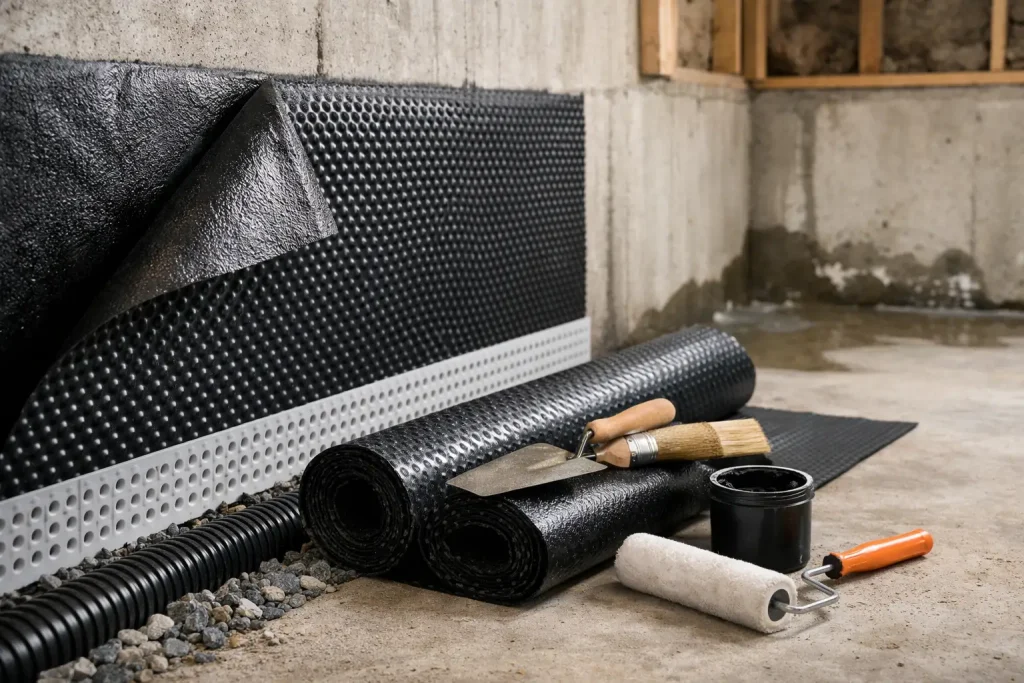
A painted basement wall can look fine right up until the first hard rain. Then the bubbles show up, the musty smell returns, and you realize the problem was never the paint. In many homes, the real line of defense is a basement waterproofing membrane – but only when it matches the way water is actually getting in.
That distinction matters. Homeowners often hear the word membrane and assume it is a one-size-fits-all fix. It is not. A membrane can be a very effective part of a waterproofing system, but the right type, placement, and supporting drainage all depend on your foundation, soil conditions, and the source of the moisture.
What a basement waterproofing membrane actually does
A basement waterproofing membrane is a barrier material installed on or against a basement wall, floor edge, or foundation exterior to control water intrusion. Its job is simple in theory: keep water from entering the basement living space. In practice, how it does that can vary a lot.
Some membranes block moisture from passing through foundation walls. Others create a drainage path that redirects water downward into a perimeter drain system. Exterior membranes typically stop water before it reaches the wall surface from the outside soil. Interior membranes usually do not stop water from touching the wall, but they manage it in a controlled way once it enters through the block, concrete, or wall joint.
That is why membrane discussions can get confusing. Two contractors may both recommend a membrane and be talking about very different systems.
Interior vs. exterior basement waterproofing membrane systems
For most homeowners, the biggest question is whether the membrane belongs outside the foundation or inside the basement.
Exterior membranes
An exterior basement waterproofing membrane is installed on the outside face of the foundation wall, usually after excavation. This approach is designed to prevent groundwater from pressing directly against the wall and entering through cracks, porous concrete, or mortar joints.
When exterior access is practical, this can be an excellent solution. It addresses water at the source and often works well when combined with footing drains, grading corrections, and crack repair. It is especially useful when the wall itself needs protection from long-term moisture exposure.
The trade-off is cost and disruption. Excavation around a home is labor-intensive. Walkways, landscaping, patios, or tight property lines can make outside work more complicated. In some New Jersey neighborhoods, limited access around the home changes what is realistic.
Interior membranes
An interior membrane is installed along the inside basement wall, often directing water down into an interior French drain or perimeter drainage channel. This type of system manages water after it penetrates the wall or reaches the wall-floor joint, then moves it toward a sump pump or drain discharge point.
This approach is often more practical and less disruptive than full excavation. It is commonly used when hydrostatic pressure pushes water through cinder block walls, wall seams, or floor joints. An interior membrane can also help keep basement finishes dry by creating separation between damp foundation surfaces and the usable space.
The trade-off is that the foundation wall may still get wet behind the membrane. That is not necessarily a failure if the system is designed to collect and remove the water properly. But it does mean interior systems are usually about water management, not exterior exclusion.
When a membrane helps – and when it is not enough
A membrane can be a smart solution, but it is rarely the whole story.
If your basement has occasional seepage where the wall meets the floor, a membrane paired with perimeter drainage may solve the problem very effectively. If you have a cracked wall with lateral movement, a membrane alone will not address the structural issue. If water is entering because gutters dump too much runoff near the foundation, drainage corrections outside should be part of the plan.
This is where honest inspection matters. Wet basement problems often have overlapping causes: surface water, hydrostatic pressure, poor grading, failing drain tile, wall cracks, porous masonry, or high humidity. Treating every moisture issue with the same product is how homeowners end up paying twice.
Signs your basement may need a waterproofing membrane
You do not need standing water to justify a closer look. Many basement water problems start with smaller warning signs that are easy to dismiss.
If you notice peeling paint, white chalky residue on walls, damp spots after storms, a persistent musty smell, warped paneling, mold growth, or water stains along the floor edge, moisture is already making its way into the space. In finished basements, the clues may show up as ruined trim, wet carpet edges, or unexplained humidity.
Block foundation walls deserve special attention. Water can fill the hollow cores of concrete block and leak out at joints or near the slab. In those cases, an interior membrane and drainage system often make more sense than a simple wall coating.
Common membrane materials and how they differ
Not all membranes are made the same, and the differences affect performance.
Exterior membranes are often made from rubberized asphalt, polymer-modified bitumen, or heavy-duty sheet materials that adhere to the wall and resist groundwater. Some are sprayed on, while others are peel-and-stick or mechanically fastened. Durability matters here because the membrane must perform below grade for years under soil pressure.
Interior membrane systems are usually dimpled plastic sheets or similar drainage materials that create an air gap and channel water downward. They are not decorative products, and they are not meant to make a basement wall itself dry to the touch. Their value is in controlled drainage.
Simple waterproof paints and sealers are in a different category. They may help with minor vapor transmission, but they generally do not hold up against active water pressure. If water is pushing through the wall, surface coatings alone are usually a short-term patch.
Installation quality matters as much as the product
A good membrane installed poorly will still fail.
Exterior systems depend on proper wall prep, crack repair, overlap details, drainage board placement, and protection during backfilling. Interior systems depend on correct attachment, clean transitions to the drainage channel, and reliable discharge through a sump system or outlet. If any part of the chain is weak, the system can underperform.
This is one reason homeowners should ask who is actually doing the work. In-house crews with direct oversight tend to deliver more consistent workmanship than jobs handed off through layers of subcontracting. Clear communication also matters because a contractor should be able to explain what the membrane will do, what it will not do, and what other repairs may be recommended alongside it.
How to choose the right basement waterproofing membrane approach
The right answer starts with diagnosis, not product preference.
If water shows up only during heavy storms, surface runoff and exterior drainage may be the main issue. If the basement takes on moisture year-round, groundwater pressure may be the bigger factor. If the home has an older block foundation, an interior drainage membrane may be the most efficient option. If there are exterior foundation cracks and accessible excavation areas, an exterior membrane may offer stronger source control.
Budget matters too, but it should be weighed against repeat repairs. A lower-cost patch that does not address the real water path is not a bargain. On the other hand, not every home needs full excavation. The best solution is the one that fits the problem without overselling the scope.
For homeowners who want a dry basement and a clear explanation, that practical, no-pressure approach makes a difference. A-1 Basement Solutions works with that mindset: inspect carefully, explain the options plainly, and recommend the system that actually fits the home.
What to ask before you move forward
Before approving any waterproofing proposal, ask where the water is entering, why this membrane type is being recommended, and whether drainage improvements are included. Ask what happens to the water once it reaches the membrane. Ask whether cracks, sump capacity, grading, or mold concerns should be addressed at the same time.
You should also ask about the warranty and what it covers. A guarantee is only helpful when the scope of work is clearly defined and backed by a company that stands behind it.
A basement waterproofing membrane can be a strong, lasting part of a dry basement system. The key is making sure it is part of the right system, installed the right way, for the right reason. When that happens, the basement stops being a source of stress and goes back to being part of your home you can count on.