
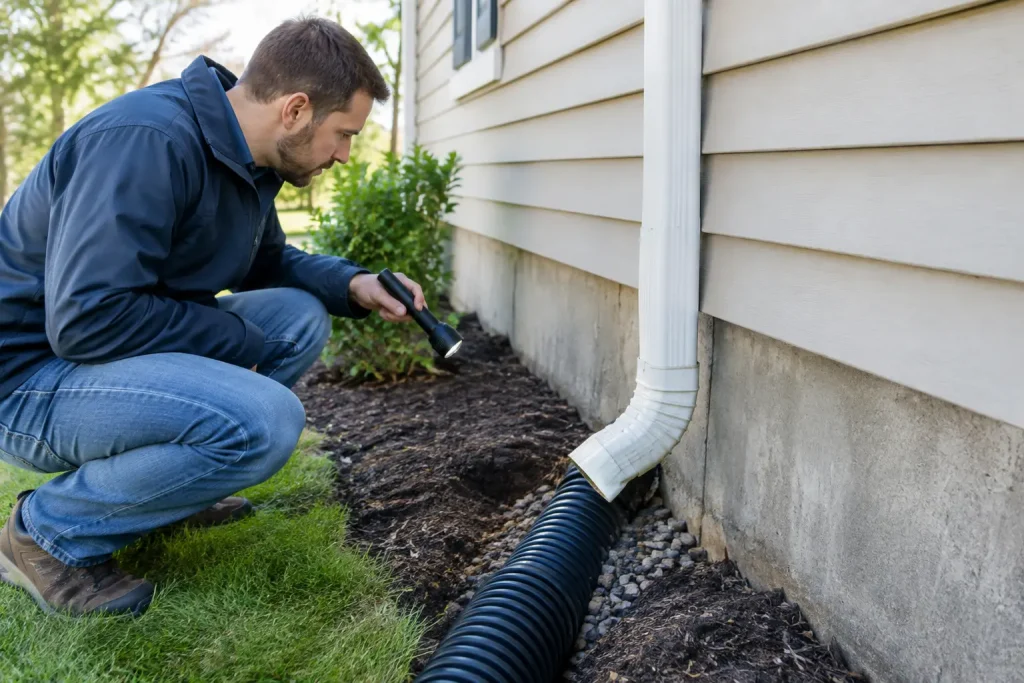
A wet basement often starts outside, long before water reaches a foundation wall or appears on the floor. Learning how to inspect foundation drainage helps you identify where water is collecting, whether it has a clear path away from the house, and when a small exterior correction may not be enough.
You do not need to be a waterproofing expert to notice warning signs. A careful walk around your home after rain, paired with a look inside the basement or crawl space, can reveal patterns worth addressing. The goal is not to diagnose every problem yourself. It is to understand what you are seeing and make informed decisions before moisture causes more damage.
Start With the Ground Around Your Foundation
The soil around your home should slope away from the foundation. This grading is one of the first lines of defense against water intrusion. When rain falls, the surface should encourage water to travel away from the house rather than settle against the walls.
Walk the perimeter and look at the ground from several angles. Pay close attention to low spots near the foundation, especially beneath roof valleys, near steps, patios, decks, and air-conditioning equipment. A shallow depression may not look serious on a dry day, but it can hold a surprising amount of water during a heavy New Jersey storm.
As a general rule, the grade should drop about 6 inches over the first 10 feet away from the house. Not every property has enough room to meet that exact measurement, and landscaping can make it harder to judge. Still, the basic question is simple: if you poured a bucket of water near the foundation, would it move away from the house or back toward it?
Mulch beds deserve a closer look as well. Mulch should not be piled high against siding, brick, or foundation walls. It can trap moisture and hide a negative grade. Keep soil and mulch below siding, and avoid creating a raised border that functions like a dam against the house.
How to Inspect Foundation Drainage After Rain
The best time to inspect drainage is during a steady rain or shortly afterward, when water is showing you exactly where it wants to go. Use caution around wet surfaces and avoid entering areas with standing water near electrical equipment.
Start at the roofline. Gutters should catch runoff without overflowing, sagging, or spilling at seams. If water pours over the side of a gutter, the problem may be debris, a loose section, or a gutter that is too small for the roof area. A single overflowing gutter can saturate the soil beside a foundation in minutes.
Then follow the downspouts. They should carry water well away from the home, not discharge beside the wall. Watch for disconnected extensions, crushed corrugated pipe, blocked underground lines, or downspouts that empty onto a driveway and send water back toward the house. In many cases, extending a downspout discharge farther away is a practical first correction. But it is not a complete solution if the yard slopes back toward the foundation or the underground drain line is blocked.
Look for these conditions as you walk:
- Puddles that remain near the foundation after rain stops
- Soil erosion, washed-out mulch, or channels cut through the yard
- Water flowing toward basement windows, exterior stairs, or bulkhead doors
- Downspout outlets that drain next to the house
- Water backing up from buried drain pipes or pop-up emitters
- Low areas along patios, walkways, and driveways that direct runoff toward the home
Standing water is the clearest sign of poor drainage, but fast-moving water matters too. Repeated runoff against one section of the house can oversaturate the soil and create uneven pressure against foundation walls.
Check Basement Windows, Doors, and Exterior Openings
Basement windows and exterior entry doors are common weak points because they sit at or below grade. Inspect window wells for leaves, sediment, broken covers, and soil that has washed into the well. A window well drain may be present, but it can clog or become disconnected over time.
If a window well fills with water, do not assume the window itself is the only problem. The larger issue may be roof runoff, poor grading, or a failed drain below the well. Water against a basement window can eventually find its way through seals, frames, or masonry joints.
For bilco doors, exterior basement stairs, and bulkhead entrances, look for ponding at the bottom of the stairwell. Check whether the drain is open and whether leaves are blocking the grate. If water stands at the door after a storm, it has more opportunity to enter through gaps or worn seals.
Look for Signs of Drainage Trouble Inside
An exterior inspection is useful, but the basement or crawl space often provides the strongest evidence of how water is affecting the home. You may not see active water every time. Moisture problems can leave behind clues long after the storm has passed.
Walk the basement perimeter with a flashlight. Look for damp spots, peeling paint, white chalky mineral deposits called efflorescence, rust on appliances or metal shelving, and dark staining along the base of foundation walls. A musty odor can also point to ongoing moisture, even when the floor looks dry.
Pay attention to where the signs appear. Moisture in one corner near a downspout may support an exterior drainage concern. Dampness across multiple walls or water coming up at the floor-wall joint may indicate hydrostatic pressure below the slab. That is when exterior improvements alone may not solve the problem.
Hairline cracks are common in concrete and are not automatically structural concerns. However, cracks that leak during rain, grow wider, run horizontally, or show wall movement deserve a professional evaluation. Drainage and foundation conditions are closely connected, so it is better to understand both rather than treat visible water as an isolated issue.
Test Your Downspout and Underground Drain Lines Carefully
If your downspouts connect to buried pipes, inspect the visible connection points for gaps, loose fittings, and backups. You can run water from a hose into the downspout or inlet for a short test, then check the discharge point. Water should exit freely away from the home.
If it backs up, disappears into the ground without reaching the outlet, or bubbles out near the foundation, stop the test. The line may be clogged, crushed, disconnected, or improperly sloped. Forcing more water into a compromised line can make the problem worse.
Do not confuse a downspout drain with a foundation footing drain. They are different systems, and homes vary widely in how they are built. Older homes may have limited exterior drainage, while newer homes may have buried systems that require professional camera inspection to assess properly.
Know When the Problem Is Bigger Than Yard Grading
Regrading soil and extending downspouts can make a real difference when water is primarily coming from the surface. Those corrections are worthwhile, especially when the problem is isolated and the basement stays dry after improvements.
But recurring seepage, water at the floor-wall joint, persistent humidity, mold growth, or a sump pump that runs constantly may point to a broader water-management issue. Interior French drains, sump pump systems, exterior waterproofing, or repairs to damaged drainage lines may be appropriate depending on the home and the source of water.
There is no one-size-fits-all repair. The right solution depends on the age of the house, the soil, the slope of the lot, the location of the water, and whether the issue occurs only in extreme storms or after ordinary rain. A good inspection should explain the cause clearly, present realistic options, and avoid pressure tactics.
When to Call a Professional
Call for a professional drainage and waterproofing evaluation if you see repeated basement water, mold or a strong musty smell, foundation cracks that are changing, pooling water that returns after basic corrections, or downspout lines that appear blocked underground. These are not problems to ignore until the next major storm.
At A-1 Basement Solutions, the focus is on identifying the source of moisture and recommending a practical path forward, not creating fear around every damp spot. A clear assessment can help you decide whether the fix is simple exterior drainage work or a more complete basement protection system.
A dry foundation begins with water having somewhere else to go. Check your property after the next rain, take note of what you find, and address the pattern before it becomes a recurring problem inside your home.