
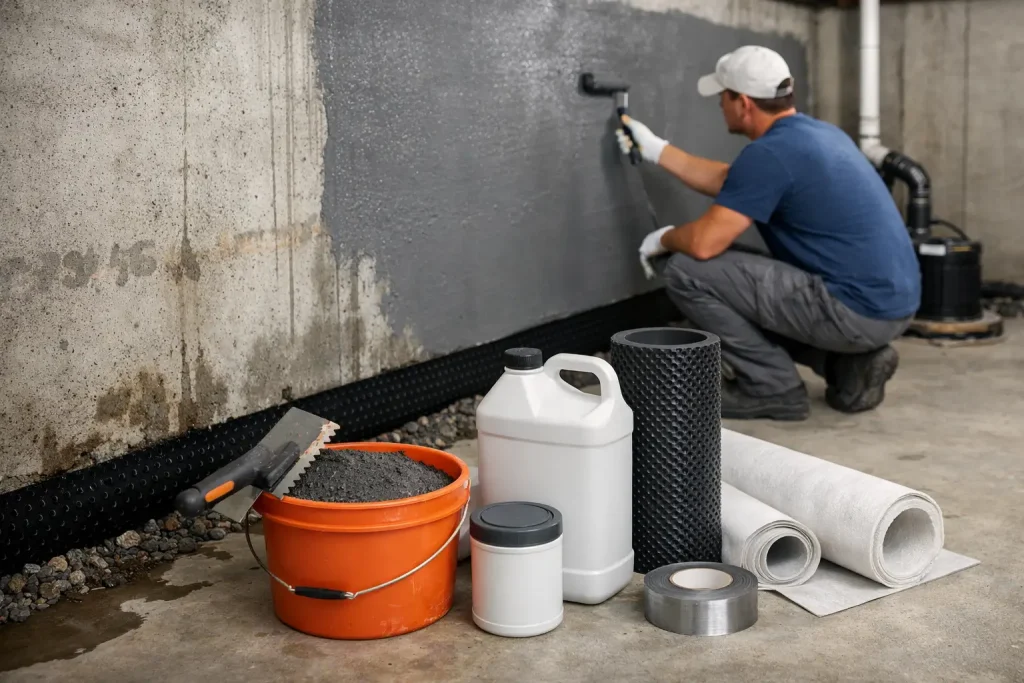
A basement that only gets damp “once in a while” usually turns into a bigger problem than homeowners expect. Musty air, peeling paint, puddles near the wall, and that one corner that always feels cold and wet are often early signs that the wrong fix is being used. When people search for the best interior basement waterproofing products, they are usually trying to solve a real moisture problem quickly, without wasting money on products that only hide the symptoms.
The truth is simple. Some interior waterproofing products are useful, but they do very different jobs. A masonry sealer is not the same as a crack repair material. A sump pump is not the same as an interior drain system. And if hydrostatic pressure is pushing water up through the floor or in at the wall joint, no coating alone is going to stop it for long.
What the best interior basement waterproofing products actually do
The best interior basement waterproofing products either block minor moisture, manage incoming water, or redirect it safely out of the basement. That distinction matters. Homeowners often buy a bucket of waterproof paint expecting it to solve active seepage, when the real issue is pressure building outside the foundation.
Interior products work best when they are matched to the source of the water. If moisture is passing through porous concrete, a penetrating sealer may help reduce vapor transmission. If a single crack is leaking, an injection material may be the right answer. If water is entering along the cove joint where the wall meets the floor, the reliable solution is usually an interior drainage system paired with a sump pump.
That is why there is no single best product for every basement. There is only the best fit for the condition you actually have.
Best interior basement waterproofing products by problem type
Waterproof masonry sealers
These are the products most homeowners recognize first. They are rolled or brushed onto concrete or masonry walls to reduce moisture penetration. In the right setting, they can help with mild dampness and improve the feel of a basement space.
Their limitation is just as important as their benefit. Sealers are surface treatments. They do not relieve outside water pressure, and they do not fix structural cracks or drainage failures. If the wall already has active leaking, flaking, or movement, a coating usually becomes a temporary cosmetic layer rather than a real repair.
For unfinished basements with minor moisture staining and no standing water, a quality masonry sealer can be part of the solution. It should not be treated as the whole solution if water is entering regularly.
Polyurethane and epoxy crack injection materials
When water is coming through a visible foundation crack, injection products can be effective. Polyurethane is often used for active leaks because it expands and helps seal water paths. Epoxy is more rigid and may be used when structural bonding is part of the goal.
This is one area where product choice depends heavily on the crack itself. A hairline shrinkage crack is different from a moving crack caused by settlement or pressure. If the wall is bowing, shifting, or cracking in multiple places, injection alone may not address the real cause.
Used correctly, crack repair materials are among the best interior basement waterproofing products for isolated wall leakage. Used on the wrong crack, they become another short-term patch.
Hydraulic cement
Hydraulic cement is commonly used to plug holes and stop localized seepage around pipe penetrations or small openings in masonry. It sets quickly and can work well as part of a targeted repair.
It also gets overused. Homeowners sometimes apply hydraulic cement to larger problem areas expecting a permanent cure. If the surrounding wall or floor is under constant water pressure, the repair may hold for a while and then fail nearby. Water usually finds the next weak spot.
Hydraulic cement has value, but it is best for small, specific openings rather than broad waterproofing.
Interior drainage channel systems
For basements that take on water where the wall meets the floor, an interior drainage system is often the most dependable answer. These systems are installed along the inside perimeter to capture incoming water before it reaches the basement floor. That water is then directed to a sump basin and discharged safely away from the home.
This is less of a store-shelf product and more of a system, but it belongs in any serious conversation about the best interior basement waterproofing products because it addresses the problem that coatings cannot. Instead of trying to hold back water pressure at the interior surface, it manages the water in a controlled way.
For many New Jersey homes with recurring seepage, this is the product category that makes the biggest difference. It is especially effective when paired with wall vapor management and a reliable sump pump.
Sump pumps and battery backup systems
A sump pump is the engine behind many interior waterproofing systems. Once water is collected, it has to go somewhere. A dependable pump moves that water out before it can rise onto the basement floor.
Not all sump pumps perform the same way. Capacity, switch reliability, basin design, and discharge setup all matter. So does backup power. A battery backup pump is not a luxury item when storms knock out electricity at the exact moment groundwater is rising.
If your basement has an interior drain or known groundwater issues, a quality sump pump setup is one of the smartest waterproofing investments you can make. The best product on paper still needs proper installation to work when it counts.
Vapor barriers and wall systems
Some interior wall products are designed to guide wall moisture down into a drainage system rather than letting it enter the living space. These can help create a cleaner, drier basement environment, especially if the space will be finished.
They are helpful, but they are not a substitute for drainage. Think of them as part of a complete moisture-control strategy. If the basement smells damp, shows condensation, or has recurring wall moisture, these systems can improve performance when used with the right underlying waterproofing work.
Products that often disappoint homeowners
Waterproof paint is the big one. It has a place in low-moisture situations, but it is often sold as if it can solve basement leaks on its own. It usually cannot. The same goes for generic caulk repairs along the floor edge or quick patch kits applied without identifying where the water is really coming from.
Dehumidifiers are helpful for air quality and comfort, but they are not waterproofing products. They manage humidity after moisture is already present. If water is entering through the foundation, a dehumidifier treats the symptom, not the source.
That does not mean these products are useless. It means they need to be used honestly. A good contractor should tell you when a product is enough and when it is not.
How to choose the right interior waterproofing solution
Start by identifying the water pattern. Is the problem a single wall crack, damp walls, seepage at the floor joint, or water coming up through the slab? Those details change the answer.
Next, look at frequency. If the basement gets wet once every few years during an extreme storm, the fix may be different than a basement that smells musty all summer and leaks during every heavy rain. Repeated water entry usually points to drainage pressure that needs a system-based solution.
Then consider your plans for the space. If you want to finish the basement, product quality matters even more. Hidden moisture behind drywall leads to mold, odor, and damaged materials. In that case, relying on paint or a patch product is usually a gamble.
This is also where professional inspection helps. An experienced waterproofing specialist can tell the difference between minor surface moisture and a drainage problem that will keep coming back. Companies like A-1 Basement Solutions build recommendations around the actual cause, not a one-size-fits-all product pitch.
When interior products are enough and when they are not
Interior basement waterproofing products can work very well, but only within the limits of the problem. For a small crack, a targeted repair may be all you need. For mild moisture vapor, a sealer and dehumidification plan may improve conditions significantly.
But if you have active water intrusion, recurring puddles, or signs of pressure at multiple points, the best answer is usually a professionally installed interior drainage and sump pump system. That is still an interior waterproofing solution, just a more complete one.
Homeowners often feel frustrated after trying two or three products that promised an easy fix. That frustration is understandable. Basement water problems are rarely solved by wishful thinking or packaging claims. They are solved by matching the method to the moisture source.
A dry basement is not about buying the most expensive product on the shelf. It is about choosing the product or system that actually fits the way water is getting in. When that part is handled correctly, the rest of the home feels easier to protect.