
A door that used to swing shut without a problem now sticks every morning. A thin crack above the living room window keeps getting longer. The basement wall has a line in it that you do not remember seeing last year. These are some of the top signs of foundation settlement, and while not every symptom points to a major structural issue, none of them should be ignored.
Foundation settlement happens when a home shifts because the soil beneath it moves, compresses, or loses its ability to support the structure evenly. In New Jersey, that can be tied to changing moisture levels, poor drainage, seasonal freeze-thaw cycles, or construction and soil conditions that have been developing for years. The key is catching the warning signs early, before a manageable repair becomes a much larger project.
What foundation settlement actually looks like
Many homeowners expect foundation problems to be dramatic. Sometimes they are. More often, settlement starts with small changes that show up in places you use every day.
A settling home does not always mean the entire foundation is failing. In many cases, one section moves more than another. That uneven movement creates stress throughout the structure, and the house starts showing you where the pressure is building. You may see it in the basement first, but just as often, the clues appear upstairs around windows, trim, floors, and drywall.
That is why the most useful approach is not to focus on one crack or one sticky door in isolation. It is better to look at the whole pattern.
Top signs of foundation settlement to watch for
1. Cracks in basement walls or foundation walls
This is one of the most obvious warning signs, but it also needs context. Not every crack is structural. Concrete can develop minor shrinkage cracks as it cures, and older homes often have cosmetic cracking that has not changed in years.
The concern rises when cracks are growing, widening, or appearing alongside other symptoms. Horizontal cracks, stair-step cracks in block walls, and diagonal cracks extending from corners often deserve closer attention. If you notice displacement, where one side of the crack sits slightly forward of the other, that is even more reason to schedule an inspection.
2. Cracks above doors and windows
When a foundation settles unevenly, the framing above openings is often one of the first places stress appears. You might see diagonal cracks running from the corners of a window or door frame. They may start hairline-thin, then slowly become more visible over time.
These cracks are easy to dismiss as normal settling, especially in older homes. Sometimes they are minor. But if they keep reopening after patching, or if several are appearing in different rooms, it is worth looking deeper.
3. Doors and windows that stick or will not latch properly
A sticking door does not always mean foundation trouble. Humidity can swell wood, and normal wear can throw hardware out of alignment. The problem is when several doors or windows begin acting differently at the same time, especially if they are near areas where you are also seeing cracks.
Settlement can slightly rack the frame of the house, turning square openings into something just off enough to affect operation. A door that rubs at the top, a window that suddenly becomes hard to open, or a latch that no longer lines up can all point to structural movement.
4. Uneven or sloping floors
Floors can slope for a range of reasons, including framing issues, aging materials, or foundation movement. In older New Jersey homes, some unevenness may have been there for decades. What matters is whether it is getting worse or showing up with other signs.
If you feel a noticeable dip, a bounce, or a tilt where floors used to feel level, pay attention. Settlement below can transfer through support beams and framing, making the issue visible well above the foundation itself.
5. Gaps around trim, cabinets, or molding
As a home shifts, finish materials tend to separate. You may notice crown molding pulling away from the ceiling, baseboards opening up at the wall, or a gap forming between a cabinet and the wall beside it.
These changes are subtle, which is why homeowners often attribute them to age or seasonal movement. Sometimes that is true. But when those gaps are new, growing, or appearing in combination with cracks and sticking doors, they can be part of the same settlement pattern.
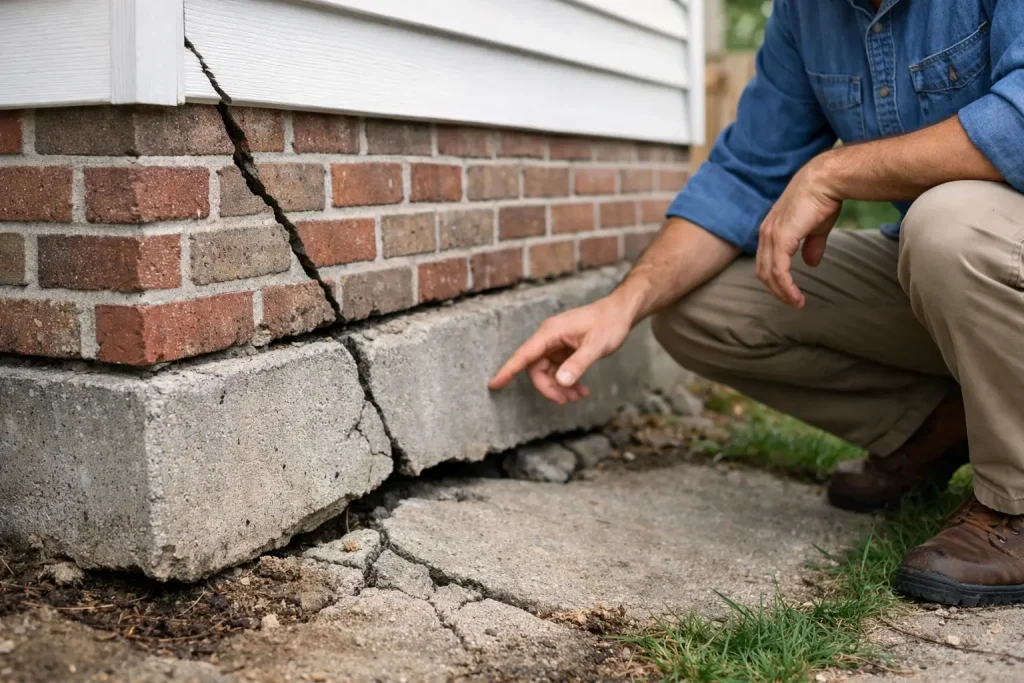
6. Cracked or separated exterior brickwork
On the outside of the home, settlement often shows up in masonry. Stair-step cracks in brick joints are a common indicator that one area of the foundation is moving differently than another. You may also see separation near garage doors, window openings, or where additions connect to the main structure.
Exterior cracks matter because they can reveal movement that started below grade and is now transferring upward. They can also create paths for water intrusion, which may add another layer of damage if left unaddressed.
7. A leaning or bowing basement wall
This one is more urgent. A wall that appears to lean inward or bow is not just a cosmetic issue. While bowing can be related to soil pressure and water outside the foundation, settlement and drainage problems often overlap.
If you see a basement wall curving, bulging, or cracking horizontally, that is a sign to act quickly. Structural movement rarely corrects itself, and moisture around the foundation can keep making the pressure worse.
8. Water intrusion alongside structural symptoms
Water alone does not prove foundation settlement, but it often plays a major role. Poor drainage, hydrostatic pressure, and saturated soil can weaken support around the foundation and contribute to movement over time.
If you have basement leaks, damp walls, musty odors, or recurring puddling near the foundation at the same time you are seeing cracks or shifting, those issues should be evaluated together. Treating only the water or only the crack can miss the root cause.
When these signs are serious and when they may not be
This is where honesty matters. Homes move a little. Materials expand and contract. A single hairline drywall crack in a house that has not changed in years is not the same as multiple growing cracks paired with sloping floors and sticking doors.
What raises concern is change. If a crack is widening, if new symptoms are appearing in different parts of the house, or if seasonal moisture seems to make everything worse, the problem deserves professional attention. The same is true if you have bought a home recently and are seeing signs that were patched before the sale.
There is also a difference between cosmetic settling and structural settlement. Cosmetic issues affect appearance. Structural settlement affects how the home is supported and how loads are being carried. Homeowners should not be expected to sort that out alone, and a good inspection should explain the difference clearly without scare tactics.
Why New Jersey homes are especially vulnerable
In this region, soil movement and water management are often tied together. Heavy rains, freeze-thaw cycles, clogged or undersized drainage systems, and grading that sends water toward the house can all affect foundation performance. Some homes are built on soils that expand and contract more than others. Some have older foundations that have been under stress for years before symptoms finally appear.
That is why a foundation issue is rarely just about concrete. It may involve exterior drainage, basement waterproofing, crawl space conditions, or the way water is collecting around the home. A repair plan that ignores those factors can leave homeowners dealing with the same problem again later.
What to do if you notice the top signs of foundation settlement
Start by documenting what you see. Take photos of cracks, gaps, or wall movement, and note whether doors or windows are getting worse. This gives you a timeline and helps identify whether the issue is active.
Next, avoid the temptation to patch everything and hope for the best. Cosmetic repairs can hide progression. If the underlying cause is settlement, those cracks often come back.
The better step is to schedule a professional inspection with a company that looks at the full picture, including structural conditions, drainage, moisture, and basement health. At A-1 Basement Solutions, that solutions-first approach matters because homeowners need a clear explanation of what is happening, what is urgent, and what can be monitored without pressure.
A good inspection should leave you with answers, not confusion. You should understand whether the issue is minor, whether repairs are needed now, and whether water control measures are part of the long-term fix.
The earlier you catch foundation settlement, the more options you usually have. And when a house is showing you changes, paying attention early is one of the best ways to protect its value, safety, and stability.