

Every spring and autumn, thousands of well-meaning homeowners in New Jersey head to their local home improvement store to confront a damp, weeping basement. They walk out with several five-gallon buckets of heavy-duty retail waterproofing paint or masonry sealant, confident that a thick DIY coating will solve their moisture problems. Initially, the results look fantastic—clean, bright, and bone-dry. Yet, within a single season, the inevitable occurs: the paint begins to bubble, blister, and flake off the masonry walls in chalky sheets.
If you have experienced this frustrating cycle in your Union, Bergen, or Morris County home, you are not alone. The truth is, waterproofing paint failure is not a reflection of your application technique or the brand of sealant you purchased. It is a symptom of a basic law of physics that topical coatings are fundamentally unequipped to handle. To achieve a permanently dry home, you must shift your approach from blocking water to managing its hydraulic forces.
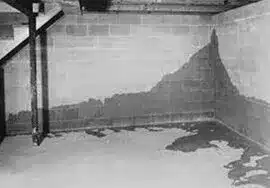
The Physics of Failure: Why Topical Sealants Can’t Hold Back the Earth
Retail masonry coatings attempt to establish what professional engineers call a negative-side waterproofing barrier. This means the coating is applied to the inside of the basement structure, trying to stop groundwater after* it has already penetrated through the thickness of your exterior foundation walls.
The core catalyst behind waterproofing paint failure is a phenomenon known as hydrostatic pressure. Northern and Central New Jersey are characterized by dense, clay-heavy soils that retain immense amounts of water. Following a heavy storm or a classic regional Nor’easter, the groundwater table surrounding your foundation rises rapidly. Because water is incredibly heavy—weighing roughly 62.4 pounds per cubic foot—this saturated soil exerts thousands of pounds of lateral, horizontal force against your underground concrete blocks.
Concrete block foundations are inherently porous, acting like massive, rigid sponges. As groundwater migrates through the block cores, it seeks an escape route into your open basement. When it encounters a layer of waterproofing paint on the interior face, it traps the moisture right beneath the surface of the film. Over time, this intense, continuous hydraulic pressure effortlessly breaks the mechanical bond of the paint, causing it to separate from the masonry, blister, and peel away completely.
⚠️ The Hidden Hazard: Internal Foundation Degradation
Trapping water inside a concrete block wall with a negative-side sealant isn’t just an aesthetic nuisance; it actively threatens the structural life of your foundation. When water remains locked inside the hollow core spaces of the block, it dissolves the natural lime and binders holding the masonry together. This structural leaching process manifests as a heavy, white powder known as efflorescence, which slowly rots the block cores from the inside out.
The Permanent Alternative: Sub-Floor Pressure Relief
To eliminate basement water permanently, you cannot fight hydrostatic pressure with a bucket of paint; you must completely relieve it. Instead of attempting to turn your basement into a submarine hull, an engineered interior sub-floor drainage system—commonly known as an internal French drain—intercepts and routes groundwater safely away before it ever builds pressure against your living space.
The mechanical blueprint of a permanent sub-floor waterproofing system consists of four critical, engineered phases:
- Perimeter Footing Trenching: A targeted section of the concrete floor slab is carefully opened along the perimeter of the basement walls, exposing the solid structural footing beneath.
- Hollow Core Weep Holes: Precision weep holes are drilled directly into the very bottom row of the concrete blocks. This immediately releases the hydrostatic pressure, allowing water trapped inside the hollow block cores to drain out dynamically into the trench rather than pressing through your interior walls.
- Perforated Drainage Channeling: A continuous, heavy-duty perforated drainage pipe is nestled into the trench, surrounded by a custom bed of clean, washed aggregate stone to screen out fine soil sediment and protect the line from clogging.
- Mechanical Discharge: The sub-floor channel collects and gravity-feeds the subterranean runoff directly into a heavy-duty, high-capacity sump pump basin. This basin is outfitted with a primary pump, a secondary backup pump, and an automated battery power supply to ensure uninterrupted discharge during severe local grid failures.
💡 Lowering the Localized Water Table
By routing groundwater directly into a sub-floor drainage system, you are physically lowering the subterranean water table by up to 8 inches beneath your concrete slab floor. This continuous hydraulic relief completely neutralizes the upward and lateral forces that cause wet basement floors and bowing walls.
The A-1 Assurance: Ethical, Subcontractor-Free Craftsmanship
At A-1 Basement Solutions, we don’t believe in temporary band-aids or superficial quick-fixes. Guided closely by the ethical framework of the Rotarian 4-Way Test, our mission is to deliver absolute transparency and long-term value to New Jersey families. We only recommend permanent, scientifically proven engineering methods tailored to your home’s unique soil and architectural conditions.
We believe that permanent structural work requires absolute accountability. That is why our projects are executed exclusively by our own 100% W2 internal employee crews. We never delegate your home’s safety to unverified, third-party subcontractors. Every system we install is engineered to the highest industry standards and backed proudly by our signature Transferable Life-of-the-House Guarantee, ensuring your home equity remains fully protected for future generations.
Stop Painting Over the Problem
If you’re tired of scraping peeling paint and dealing with a chronically damp, musty basement, it is time for a permanent engineered solution.
Contact A-1 Basement Solutions today to schedule your comprehensive, professional in-home evaluation and moisture diagnostic assessment.📞 Call Our Specialists: (908) 322-1313
Frequently Asked Questions About Basement Waterproofing Paint Failure
Why does waterproofing paint peel off basement walls?
Waterproofing paint peels because hydrostatic pressure pushes groundwater through porous foundation walls. As moisture builds behind the coating, it eventually breaks the bond between the paint and masonry.
Does waterproofing paint actually work?
Waterproofing paint may temporarily improve the appearance of a damp basement, but it does not eliminate the source of water intrusion. In most cases, it serves as a short-term cosmetic solution rather than a permanent fix.
What is hydrostatic pressure?
Hydrostatic pressure is the force created when water accumulates in the soil surrounding your foundation. This pressure pushes moisture through concrete block walls, cracks, and floor joints.
Why do basement walls stay wet even after sealing them?
Sealants only cover the interior surface. Water can still penetrate through foundation walls and become trapped behind the coating, causing moisture buildup and eventual failure.
What is the best permanent solution for a wet basement?
A professionally installed interior drainage system combined with a sump pump is one of the most effective long-term solutions. It captures groundwater before it enters the living space and safely redirects it away from the foundation.
How does an interior French drain work?
An interior French drain collects groundwater through a perforated drainage channel installed beneath the basement floor. The water is then directed to a sump pump for discharge away from the home.
Can waterproofing paint damage my foundation?
While the paint itself does not damage the foundation, trapping moisture within concrete block walls can contribute to efflorescence, masonry deterioration, and long-term structural weakening.
What is efflorescence on basement walls?
Efflorescence is a white, powdery residue that forms when water carries dissolved minerals through concrete and masonry. It is often a sign of ongoing moisture intrusion.
Will a sump pump prevent basement flooding?
A properly sized sump pump system helps prevent flooding by removing collected groundwater before it can accumulate beneath the basement floor or around the foundation.
How do I know if I need professional basement waterproofing?
If you notice peeling waterproof paint, damp walls, musty odors, efflorescence, recurring leaks, or standing water, a professional waterproofing inspection is recommended.