
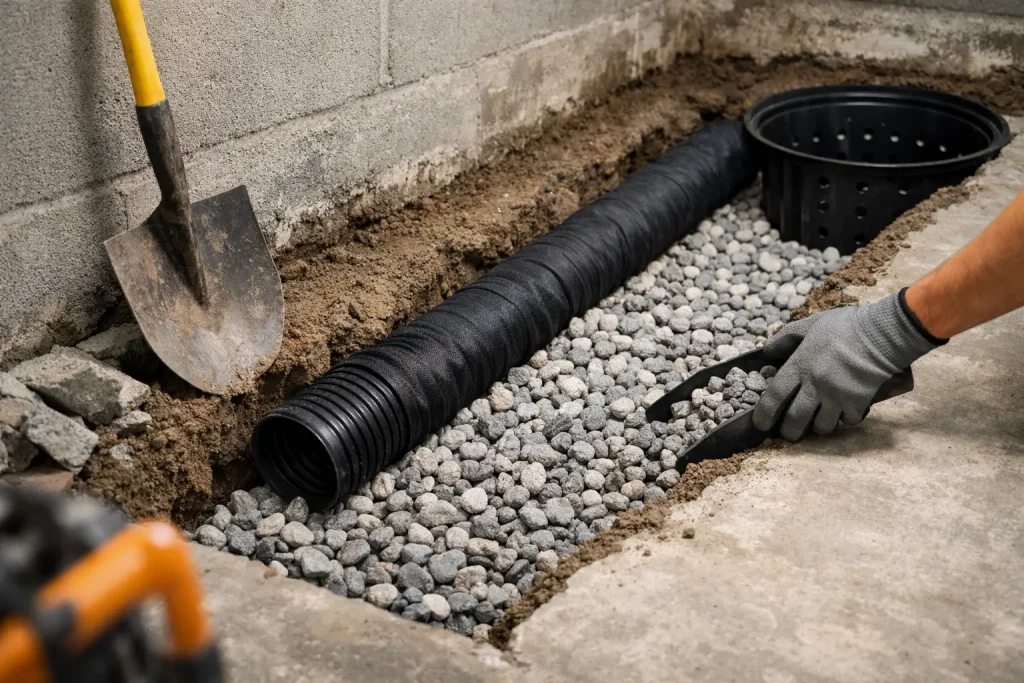
Water showing up along a basement wall usually means the problem is not the floor itself. It is pressure building outside the foundation and forcing moisture to the path of least resistance. If you are researching how to install interior french drain systems, the goal is simple: collect that water before it reaches your basement floor and direct it safely to a sump pump discharge.
For many New Jersey homeowners, an interior system is the most practical way to control recurring seepage. It can be very effective, but it is also one of those projects where the details matter. A drain that is too shallow, pitched poorly, or tied into the wrong discharge setup can leave you with the same wet basement and a fresh concrete patch to look at.
What an interior French drain actually does
An interior French drain is installed along the inside perimeter of a basement, typically at the base of the foundation wall. A trench is cut into the concrete slab, drainage stone is placed, perforated pipe or a drain channel is installed, and the system is routed to a sump basin. After that, the trench is covered back over with concrete.
This setup does not stop water from existing outside the home. What it does is relieve hydrostatic pressure by giving groundwater a controlled path to enter the system and move to the pump instead of leaking across the floor. That distinction matters because homeowners are often told they need to “seal” the water out. In many basements, pressure management works better than trying to fight water with coatings alone.
When an interior system makes sense
If water appears where the wall meets the floor, if seepage is limited to heavy rain events, or if you have an older home with chronic dampness below grade, this type of drain is often a strong solution. It also makes sense when exterior excavation would be disruptive, expensive, or impractical because of patios, driveways, porches, or neighboring properties.
That said, it is not a cure for every basement issue. If you have major wall movement, bowing, settlement, or large foundation cracks, drainage may be only part of the work. Likewise, if roof runoff, clogged gutters, or poor grading are sending too much water toward the house, those conditions should be corrected too.
How to install interior french drain step by step
The installation starts with planning, not concrete cutting. You need to identify where water is entering, where the sump basin will sit, how the line will pitch, and whether there are utilities in or below the slab. In a finished basement, you also need to account for framing, drywall, flooring, and cleanup.
Step 1: Mark the trench path
Most interior drains are installed around the perimeter of the basement, tight to the foundation wall. The trench is usually cut several inches away from the wall so there is enough room for the drain stone and collection channel. Corners, utility areas, and the path to the sump pit all need to be marked before cutting begins.
The exact layout depends on the home. Some basements need a full perimeter system. Others may need only one or two problem walls, though partial systems can be a gamble if water pressure shifts later.
Step 2: Break out the concrete slab
Once the trench path is marked, the slab is cut and jackhammered open. This is dusty, noisy work, and it needs to be contained properly. The trench depth must be sufficient to collect water below the slab level and carry it toward the sump location.
This is where many do-it-yourself attempts go wrong. Homeowners often underestimate how much concrete removal is needed or how difficult it is to maintain a consistent trench depth. A drain system is hidden once the floor is patched, so mistakes are not easy to fix later.
Step 3: Prepare the base and drainage area
After the broken concrete and soil are removed, the trench is cleaned out. A layer of washed stone is placed at the bottom to create a drainage bed. Depending on the system design, installers may also create a small gap at the wall-floor joint or use a wall drainage flange so water from the block wall or foundation seam can enter the system directly.
That wall detail matters more than many homeowners realize. Water does not always rise neatly from below. In some homes, it comes through wall cavities, masonry cores, or the cove joint where the wall and slab meet.
Step 4: Install the drain line
Now the perforated pipe or interior drainage channel is laid into the trench. The line must slope properly toward the sump basin so water flows efficiently. More stone is placed around and above the pipe to improve water movement and reduce clogging.
Fabric is sometimes used in exterior systems to separate soil from stone, but interior basement systems vary by design. The right approach depends on the soil conditions, the type of drain product used, and how the installer manages sediment. This is one reason professional systems are not all built the same.
Step 5: Connect to the sump pump basin
The drain line needs a reliable destination, and that usually means a sump pit with a properly sized pump. Water collected by the interior drain flows into the basin, then the pump discharges it away from the home.
If the pump is undersized, the discharge line is poorly routed, or the check valve is missing or installed wrong, the entire drainage system can underperform. In other words, the drain and the sump pump are one system, not two separate upgrades.
Step 6: Patch the concrete
Once the drainage line is installed and tested, the trench is covered with concrete to restore the basement floor. A clean patch matters for appearance, but function matters more. The patch should not block wall drainage points or compromise access to the sump area.
In a professionally managed project, cleanup is part of the job, not an afterthought. That is especially important in homes where the basement is used for storage, laundry, or finished living space.
Tools and materials homeowners often underestimate
On paper, the material list looks manageable: concrete saw, jackhammer, drain pipe, stone, sump basin, sump pump, discharge line, and concrete patch materials. In reality, the challenge is less about buying components and more about installing them correctly in a confined space without creating a new problem.
You are dealing with foundation edges, slab integrity, dust control, groundwater behavior, electrical power for the pump, and discharge routing outside the home. If the house has a finished basement, there is also the issue of protecting walls, trim, and flooring during demolition.
The trade-offs of doing it yourself
A homeowner with strong construction experience may be able to install a basic interior drain in a small unfinished basement. The main advantage is cost savings on labor. If you have the tools, understand drainage pitch, and know how to install a sump system safely, that may be a workable path.
The downside is that waterproofing failures are expensive to revisit. If the pitch is off, if the pipe clogs, if the wall drainage path is incomplete, or if the pump setup is weak, water comes back. Then you are paying to reopen concrete and redo work that should have been right the first time.
There is also the question of diagnosis. Some wet basement problems look like simple seepage but are actually tied to exterior grading, foundation cracking, window wells, or plumbing leaks. Installing an interior drain without identifying the source can waste time and money.
When to call a professional for an interior French drain
If the basement floods repeatedly, if multiple walls are leaking, if there is mold or musty odor, or if you see any sign of structural movement, it makes sense to bring in a specialist. The same is true if you want warranty protection or plan to finish the basement and do not want to risk hidden moisture later.
A company like A-1 Basement Solutions approaches this as a full moisture-control system, not just a trench in the floor. That includes inspection, drainage design, sump pump performance, clean installation, and long-term reliability. For most homeowners, that kind of clarity is worth more than trying to piece together a solution one part at a time.
A few mistakes to avoid
One common mistake is assuming waterproof paint will do the same job as drainage. It will not. Another is installing a drain without addressing where the pump discharges outside. If that water recirculates back toward the foundation, the system keeps fighting the same water.
Homeowners also sometimes install only the visibly wet section of basement to save money. That can work in a very specific situation, but often water simply finds the next weakest point. Basement water has a way of exposing shortcuts.
If you are deciding how to install interior french drain systems in your home, think beyond the trench itself. The best result is not just a dry floor after the next storm. It is confidence that the whole system is built to handle the water your property actually gets, year after year.